

Sales-Driven MSP vs. Engineering-Driven MSP: What Every Orange County Business Needs to Know Before Signing a Contract
Most businesses shopping for the best MSP in Orange County compare logos and price sheets — but the one question that actually determines value is this: Is your provider built to sell packages, or built to solve problems?
May 19, 2026 9 min read

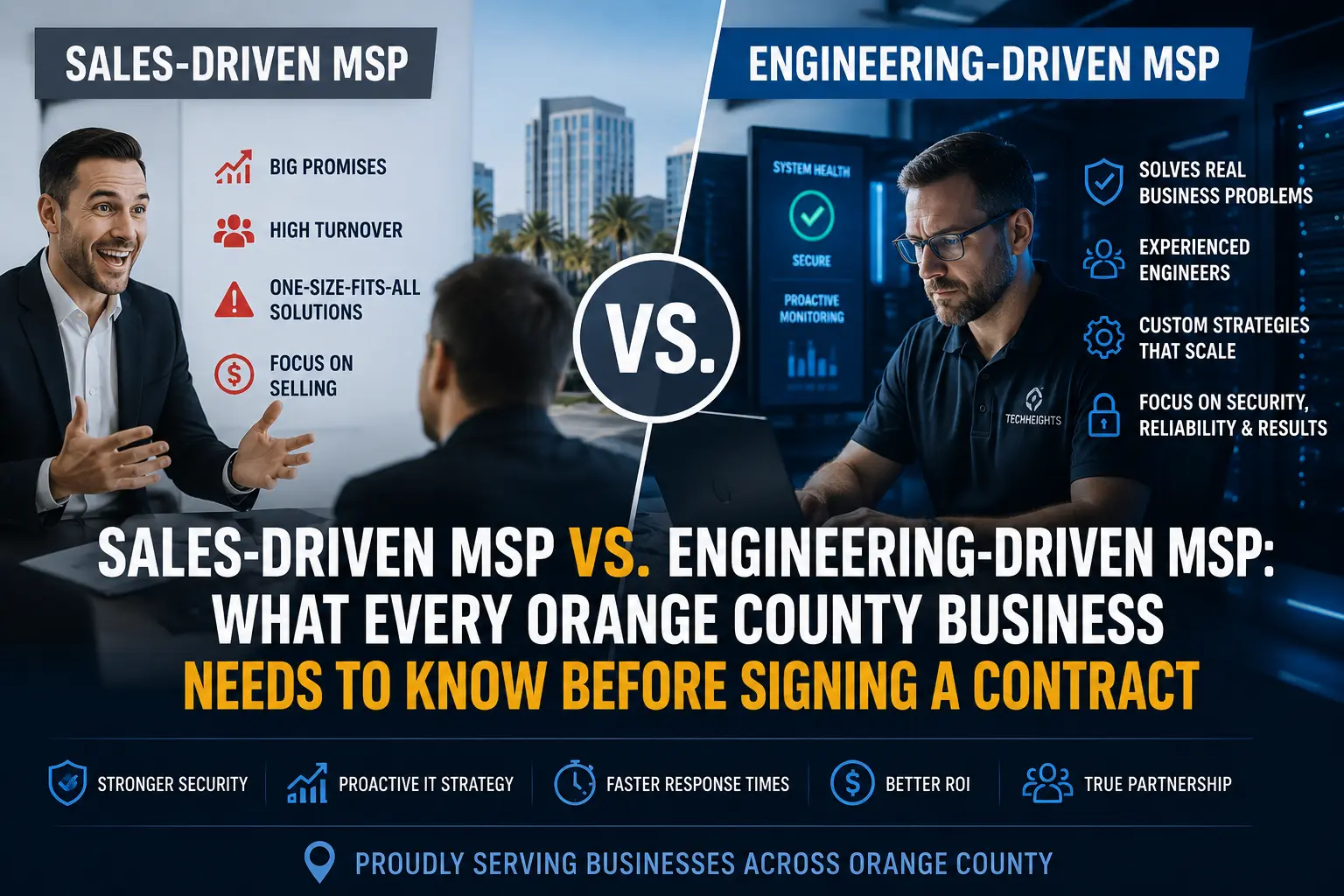
That gap in pricing — and the philosophy behind it — exposes one of the most important distinctions in the managed IT services market today: the fundamental difference between a sales-driven MSP and an engineering-driven MSP. For businesses evaluating their options across Orange County, Riverside, and the greater LA metro, understanding this distinction could mean the difference between a partnership that truly protects you and one that quietly costs you tens of thousands of dollars a year.
The Two Philosophies Shaping IT Support Today
Every managed service provider will tell you they’re the best. They’ll show you logos, certifications, awards, and polished pitch decks. But underneath the marketing, most MSPs operate from one of two core philosophies — and those philosophies determine everything about how they price, deliver, and scale their services.
A sales-driven MSP is built around a go-to-market machine. Their primary competitive advantage isn’t technical depth — it’s brand visibility, sales volume, and a well-structured marketing funnel. They grow by acquiring new clients quickly, which means they rely on standardized, pre-packaged offerings that can be sold at scale without requiring deep customization for each client. For the right type of organization, this model works. For most growing businesses, it’s a mismatch they won’t notice until the contract is signed.
An engineering-driven MSP, by contrast, builds its competitive advantage in the lab, not the boardroom. Their primary investment is in technical talent — engineers, architects, and security analysts who diagnose your environment before recommending a solution. They grow through client retention and referrals, not aggressive outreach. And because their revenue depends on actually solving problems, they’re structurally incentivized to get it right the first time.
$19,740
Annual savings for a 35-device
business choosing per-device
over per-user bundled pricing
30–45%
Cost premium businesses often
unknowingly pay for bundled
MSP packages
50+
Engineers required for
meaningful vendor
purchasing power
The Bundle Trap: How Sales-Driven MSPs Overcharge You
The core economics of a sales-driven MSP depend on simplicity at scale. The fewer variations they manage across their client base, the more efficiently they can staff and deliver. That efficiency is good for their margins — but it’s paid for by you.
The most common vehicle for this is the per-user bundle. A per-user pricing model charges a flat rate for every employee, covering every device that employee uses — office workstation, home PC, mobile device — under a single license stack. On paper, this sounds comprehensive. In practice, it means you’re purchasing a predetermined set of software tools regardless of whether your specific infrastructure actually requires them.
Consider a real-world scenario: 30 users, 35 devices. Under a per-user model priced at approximately $157 per user — consistent with the Orange County market for full-service MSPs — your monthly bill comes to roughly $4,710. But your organization doesn’t have 30 home PCs or 30 mobile devices in scope. You have 35 managed devices, period. Under a per-device model at $110, that same month costs approximately $3,850. That’s $860 per month in pure overpayment for shelfware you never needed.
The Real Cost of Bundled Pricing
For a company with 30 users and 35 total devices, choosing a rigid per-user bundle at $157/device-equivalent over a precision per-device model at $110 results in approximately $1,645 per month in unnecessary spend — or $19,740 annually. That money could fund a dedicated security upgrade, a business continuity plan, or a full compliance audit.
The deeper problem isn’t just the overpayment. It’s that sales-driven MSPs often lack the engineering depth to build a custom stack in the first place. They sell bundles because bundles are what they know how to deliver. The standardized toolset isn’t a convenience — it’s a constraint driven by limited technical breadth.
Precision Engineering: What a True IT MSP Actually Does
The clearest signal that you’re dealing with an engineering-driven MSP is that they want to understand your environment before they quote you a price. Not after. Not during onboarding. Before the contract is signed — and that means showing up in person.
Before any proposal is written, a serious MSP should come onsite. They should walk your server room, look at how your hardware is laid out, understand your cabling, check how your backups are running, and get a feel for the physical infrastructure that no remote scan can fully capture. This isn’t just due diligence — it’s the foundation of an honest proposal. An MSP that quotes you based purely on a discovery questionnaire or a 30-minute call is guessing at your needs, not diagnosing them.
Equally important: they should take time to understand how your business actually operates. They don’t need to know every software platform you use on day one — that comes with time. But they need to understand your workflows, your peak hours, your critical systems, and where a technology failure would do the most damage. The right MSP asks questions about your business, not just your network.
And critically — the business owner or a senior decision-maker should be in that room. A sales-driven MSP is happy to deal exclusively with an office manager or junior IT contact because that limits the conversation to features and price. An engineering-driven MSP wants leadership involved because they’re making recommendations that affect the entire organization. If an MSP never asks to speak with the owner or a senior stakeholder during the pre-sale process, that’s a red flag worth noting.
Beware the “National MSP” That Isn’t
A growing number of MSPs are marketing themselves as large national firms with broad capabilities — when in reality they’re a collection of small, independently operated shops stitched together under one brand after a series of private equity acquisitions. The result is disparate systems, disjointed teams, and zero collaboration between regions. Your “local” engineer in Orange County has no meaningful connection to the team in Dallas or Denver. There’s no shared knowledge base, no unified tooling, and no cohesive culture — just a logo and a rollup. When evaluating an MSP, ask directly: are all your engineers in-house employees on a single platform, or have you grown through acquisitions?
For businesses seeking IT support in Orange County, this distinction matters enormously. Orange County’s business landscape is diverse — defense contractors in Irvine, healthcare practices in Anaheim, financial firms in Newport Beach, manufacturers in Fullerton. Each carries distinct compliance requirements, distinct threat profiles, and distinct infrastructure configurations. A one-size-fits-all bundle from a PE-backed roll-up almost never fits any of them well.
What an Onsite Pre-Sale Assessment Should Include
A genuine engineering-driven MSP will walk your server room, inventory physical hardware, review your backup and recovery setup, assess network cabling and switching, identify single points of failure, and ask operational questions about your business before writing a single line of their proposal. If the “assessment” is just a form you fill out online, it isn’t an assessment — it’s a sales qualification call.
Scale Efficiency: Why Larger Engineering Teams Cost You Less
When an MSP maintains a roster of 50 or more engineers, they purchase security tools, monitoring platforms, and software licenses at enterprise volume. That volume unlocks vendor discounts that a 10-person shop simply cannot access. Those discounts — on EDR platforms, backup solutions, patch management tools, and security operations infrastructure — get passed directly to clients in the form of lower per-device pricing.
A smaller, marketing-heavy MSP with a lean technical team doesn’t have this leverage. Their tooling costs more. Their engineers are stretched thinner, covering more accounts per head. Because their differentiation is built on brand and sales volume rather than technical depth, they compensate with higher margins on bundled packages rather than competing on efficiency.
For businesses evaluating the best MSP in Orange County, this means the firm with the loudest marketing presence isn’t necessarily the firm with the strongest technical foundation. Often, it’s the opposite.
7 Questions to Expose a Sales-Driven MSP in Your First Meeting
You don’t need a technical background to distinguish between these two MSP types. The questions you ask in the first meeting will reveal the answer quickly. Here’s what to ask — and what the answers tell you:
1. “Do you conduct a free infrastructure assessment as part of your onboarding process?”
Engineering-driven answer: Yes — before we propose anything, we come onsite, walk your environment, and build a picture of what you actually have and what you actually need. Sales-driven answer: Our packages are designed to cover everything, so we can usually get started right away. If you hear that second answer, walk away. An MSP that skips the assessment isn’t protecting you — they’re selling you
2. “How is your pricing structured — per user or per device?”
Ask them to walk through the math for your specific headcount and device count. If the per-user model produces a significantly higher effective cost per device, ask why you should pay the difference.
3. “Do you provide separate line items for every tool in your cybersecurity stack, or is it bundled into one price?”
If an MSP presents cybersecurity as a single bundled line item — “security package: $X/month” — that is a red flag. You have no visibility into what you’re actually paying for, no way to verify coverage, and no ability to swap out tools that don’t fit. A credible engineering-driven MSP will itemize every component: EDR, backup, email security, vulnerability scanning, and so on. More importantly, those tools should be selected after an assessment of your environment — not handed to you pre-packaged before anyone has looked at a single server.
4. “How many engineers do you have on staff, and what’s your engineer-to-client ratio?”
Aim for an MSP with a ratio of no more than 20–25 clients per engineer for fully managed services. Higher ratios often mean slower response times and reactive rather than proactive support.
5. “What vendors do you have volume licensing agreements with, and how do those savings benefit me?”
An engineering-driven MSP with real purchasing scale can answer this specifically. If the answer is vague, the discounts may not exist — or may not be passed on to you.
6. “Can you show me a sample security assessment report from a similar client?”
This separates firms that conduct real diagnostics from firms that treat onboarding as a paperwork exercise. The quality of the report reveals the depth of the engineering team.
7. “What is your guaranteed response time when we call with a critical issue?”
This is where you separate real engineering firms from sales operations fast. If they start talking about SLAs, tiers, or “priority levels” — that is a red flag. SLA language is a way to legally protect the MSP, not to protect your business. A confident, engineering-driven MSP gives you a plain number. TechHeights, for example, commits to a response time of under 5 minutes. As a benchmark: anything over 10 minutes for a critical issue is a red flag by industry standards. If they cannot give you a specific number and instead hand you a tiered SLA document, you already have your answer.
What to Look for in an Engineering-Driven MSP
- Assessment-first approach: They conduct a detailed infrastructure scan before quoting — not after. The proposal should be specific to your environment, not a generic pricing tier.
- Per-device or hybrid pricing: They’re willing to price based on your actual managed device count rather than forcing a per-user model that inflates your bill.
- In-house engineering depth: They maintain a sizeable team — ideally 40 or more engineers — including dedicated cybersecurity specialists, not just generalist help desk technicians.
- Transparent vendor relationships: They can name their security stack, explain why each component is included, and demonstrate the purchasing agreements that reduce your tooling costs.
- Proactive security posture: Their service model is built around preventing incidents, not just responding to them. Ask about patch cadence, vulnerability scanning, and EDR coverage.
- Local presence and accountability: For businesses in Orange County and Riverside, a local team means faster on-site response and a relationship grounded in your specific regional context.
- Compliance alignment: If your industry has regulatory requirements — HIPAA, PCI DSS, CMMC — they should have dedicated compliance services expertise, not a generic framework applied to everyone.
- Verifiable client references: They can connect you with current clients of similar size and industry who can speak to service quality, response times, and actual incident outcomes.
The Bottom Line for Orange County Businesses
A sales-driven MSP will onboard you into their standard package, assign you a support tier, and manage your environment against a predetermined checklist. If your infrastructure fits their template, you’ll likely receive acceptable service. If it doesn’t — and most growing businesses don’t fit neatly into templates — you’ll find yourself paying for tools you don’t need, missing protection in areas they never assessed, and absorbing margin that benefits the MSP far more than it benefits you.
An engineering-driven MSP takes the opposite approach. They start by understanding your environment, your risk profile, and your actual gaps. They price precisely. They deploy specifically. And because their technical team is built for depth rather than volume, they have the capacity to respond intelligently when something goes wrong — not just escalate to an offshore NOC at 2 a.m.
For any Orange County business comparing options, the math is clear. At 35 managed devices, the per-device engineering-driven model doesn’t just save you nearly $20,000 a year — it delivers a better-calibrated, more defensible security posture than a bundled per-user package designed for someone else’s environment.
When you’re ready to find out exactly what your environment needs — not what a pre-built package includes — a real security assessment is the place to start. TechHeights has been providing managed IT services across Orange County since 2007, with a team of 50+ engineers and the purchasing scale to deliver enterprise-grade protection at pricing that reflects your actual infrastructure.
Find Out What Your Environment Actually Needs
TechHeights delivers managed IT services, cybersecurity, and compliance solutions trusted by 250+ businesses across Orange County and Riverside since 2007. Start with a free infrastructure assessment — and get a proposal built around your devices, not a pre-packaged bundle.