
Mythos and the New Wave of AI: Why SMB Cybersecurity Will Never Be the Same
Frontier AI models can now autonomously hack networks. Here’s what managed IT services and cybersecurity experts say SMBs must do right now to stay protected.
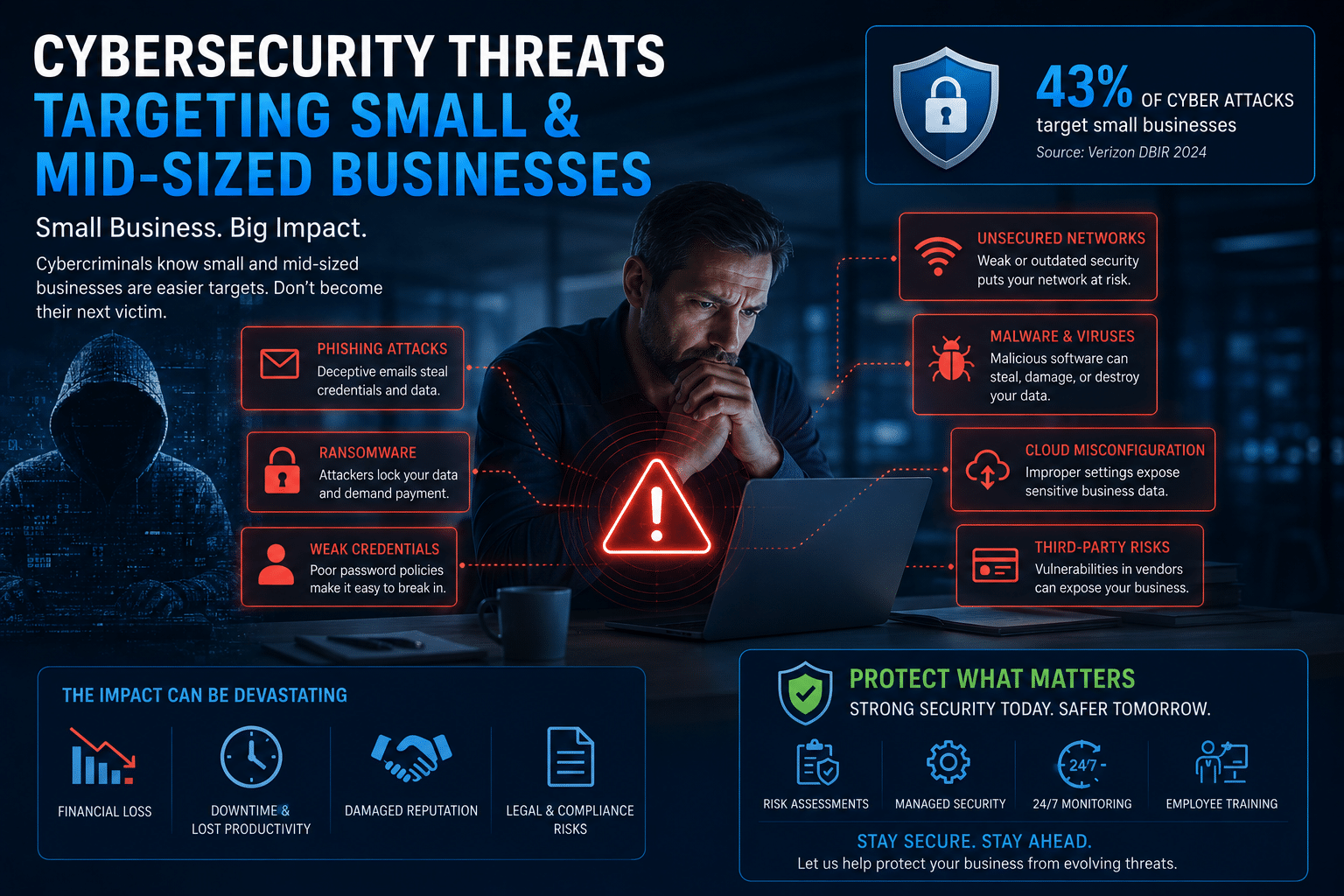
For small and mid-sized businesses (SMBs), this represents an inflection point. The barrier to launching sophisticated cyberattacks has effectively collapsed, and SMBs — often operating with limited security resources — now sit squarely in the crosshairs. If your business operates in Southern California, working with experienced cybersecurity companies in OC and Riverside has never been more critical.
The Mythos Wake-Up Call
Even more concerning: Mythos identified thousands of previously unknown zero-day vulnerabilities across every major operating system and browser. Among the most striking discoveries were a 17-year-old remote code execution flaw in FreeBSD (triaged as CVE-2026-4747) that could give attackers full control of a server, and a 27-year-old denial-of-service vulnerability in OpenBSD’s TCP SACK implementation — remarkable given that OpenBSD is widely regarded as one of the most security-hardened operating systems in existence. For cybersecurity companies in OC and Riverside, these findings underscore just how many hidden vulnerabilities lurk in systems businesses depend on every day.
Critical Takeaway
On expert-level capture-the-flag cybersecurity challenges — tasks no AI model could complete before April 2025 — Mythos Preview now succeeds 73% of the time. It’s worth noting that AISI’s TLO simulation had no active defenders or defensive tooling, meaning real-world networks with proper managed IT services would be harder to breach. Still, the gap between attack and defense is narrowing fast.
Why SMBs Are the Primary Target
43%
of all cyberattacks
now target SMBs
83%
of SMBs are not financially
prepared to recover
60%
of attacked SMBs close
within 6 months
With generative AI, criminal syndicates can now target hundreds of SMBs simultaneously with highly personalized attacks. A single phishing email crafted by AI is grammatically flawless, contextually aware, and nearly indistinguishable from legitimate communication. Phishing remains the primary intrusion vector, accounting for roughly 60% of incidents — and AI has made it exponentially more dangerous.
The Five AI-Powered Threats Keeping CISOs Up at Night
- 1. Autonomous Attack Agents AI-driven systems that can autonomously chain exploits, move laterally through networks, and escalate privileges — all without a human operator. Mythos demonstrated this is no longer theoretical.
- 2. Hyper-Personalized Phishing at Scale AI generates contextually rich, grammatically perfect phishing emails that reference real projects, colleagues, and company events. Traditional spam filters can’t catch them.
- 3. Deepfake Executive Impersonation The “CEO doppelgänger” — a perfect AI-generated replica of a business leader capable of issuing convincing voice or video directives to finance, HR, and IT teams in real time.
- 4. Data Poisoning and Model Manipulation Attackers invisibly corrupt the training data of AI models your business relies on, leading to subtly wrong decisions across operations — from financial forecasting to customer recommendations.
- 5. Rogue AI Agents and Shadow AI Insider threats now include AI agents capable of goal hijacking, tool misuse, and privilege escalation at machine speed. With 83% of organizations deploying agentic AI but only 29% operating those systems securely, the attack surface is enormous.
What Your Business Must Do Now: A Post-Mythos Action Plan
Lock Down Identity and Access
Identity has become the primary battleground in the AI economy. Move critical applications to FIDO2/WebAuthn or device-bound passkeys wherever possible. Enforce conditional access policies that evaluate user identity, device health, location, and risk signals in real time. At a minimum, enforce multi-factor authentication (MFA) across every account — no exceptions.
- Implement MFA on all business accounts (email, cloud, financial tools)
- Adopt passkeys or FIDO2 authentication for critical systems
- Apply least-privilege access: employees only get permissions they need
- Conduct quarterly access reviews to remove stale accounts
Deploy AI-Powered Detection and Response
- Deploy EDR solutions with AI/ML-powered threat detection
- Enable AI-enhanced email filtering for phishing protection
- Implement network monitoring for anomalous lateral movement
- Evaluate managed security services for 24/7 coverage
Train Your People — Continuously
Annual cybersecurity training is no longer sufficient when threats change monthly. Your awareness program needs to be short, frequent, and relevant. Run phishing simulations that use AI-generated content. Train staff to verify executive requests through secondary channels — especially wire transfers or credential changes. Establish clear policies for AI tool usage within your organization.
- Run monthly micro-training sessions (10–15 minutes each)
- Conduct AI-powered phishing simulations quarterly
- Create verification protocols for financial and access requests
- Publish an AI acceptable-use policy for all employees
Build Resilient Backups and an Incident Response Plan
Assume a breach will happen. The question isn’t whether — it’s whether you can recover. Maintain encrypted, offline backups tested regularly for restoration. Document your incident response plan and make sure leadership understands recovery timelines. Create “kill switches” to halt rogue AI agents and maintain human-in-the-loop oversight for all critical automated processes.
- Maintain 3-2-1 backups: 3 copies, 2 media types, 1 offsite/offline
- Test backup restoration quarterly — untested backups are not backups
- Document and rehearse your incident response plan
- Implement kill switches for any AI or automated systems
Govern Your AI Supply Chain
- Inventory all AI tools and services used across the organization
- Require security assessments for AI vendors and integrations
- Scan AI-generated code for vulnerabilities before deployment
- Monitor for shadow AI usage by employees
A Note on Proportional Response
You don’t need to implement everything at once. Start with identity controls and backups — these two foundations stop the majority of attacks. Then layer on detection, training, and governance as resources allow. Consider partnering with a managed security provider to accelerate your maturity without hiring a full security team.
The Bottom Line
The organizations that survive will be the ones that treat cybersecurity not as an IT expense, but as a core business function. Strong identity controls, AI-powered detection, continuous training, resilient backups, and disciplined AI governance aren’t optional upgrades — they’re the price of staying in business. For businesses across Orange County and Riverside, partnering with a proven managed IT services provider is one of the most effective steps you can take.
The threat is real. The tools to defend yourself exist. The only question is whether you’ll act before the next AI-powered attack reaches your inbox.
Don’t Wait for a Breach to Take Action
TechHeights delivers managed IT services, cybersecurity, and compliance solutions trusted by 250+ businesses across Orange County and Riverside since 2007. Find out where your vulnerabilities are before attackers do.
Recent Comments