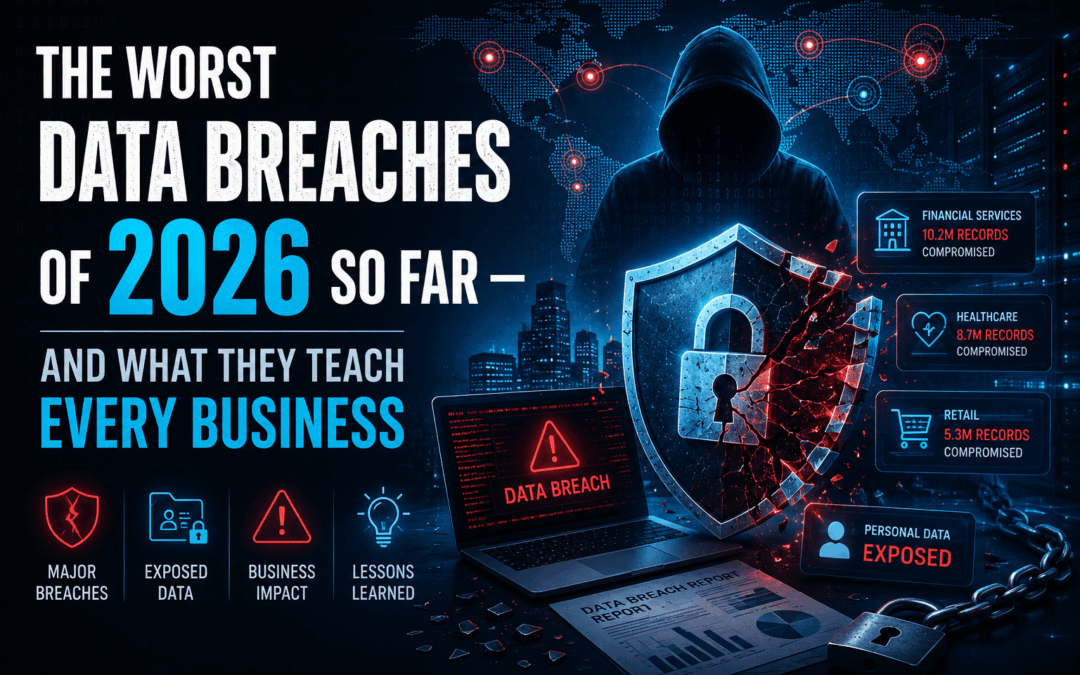
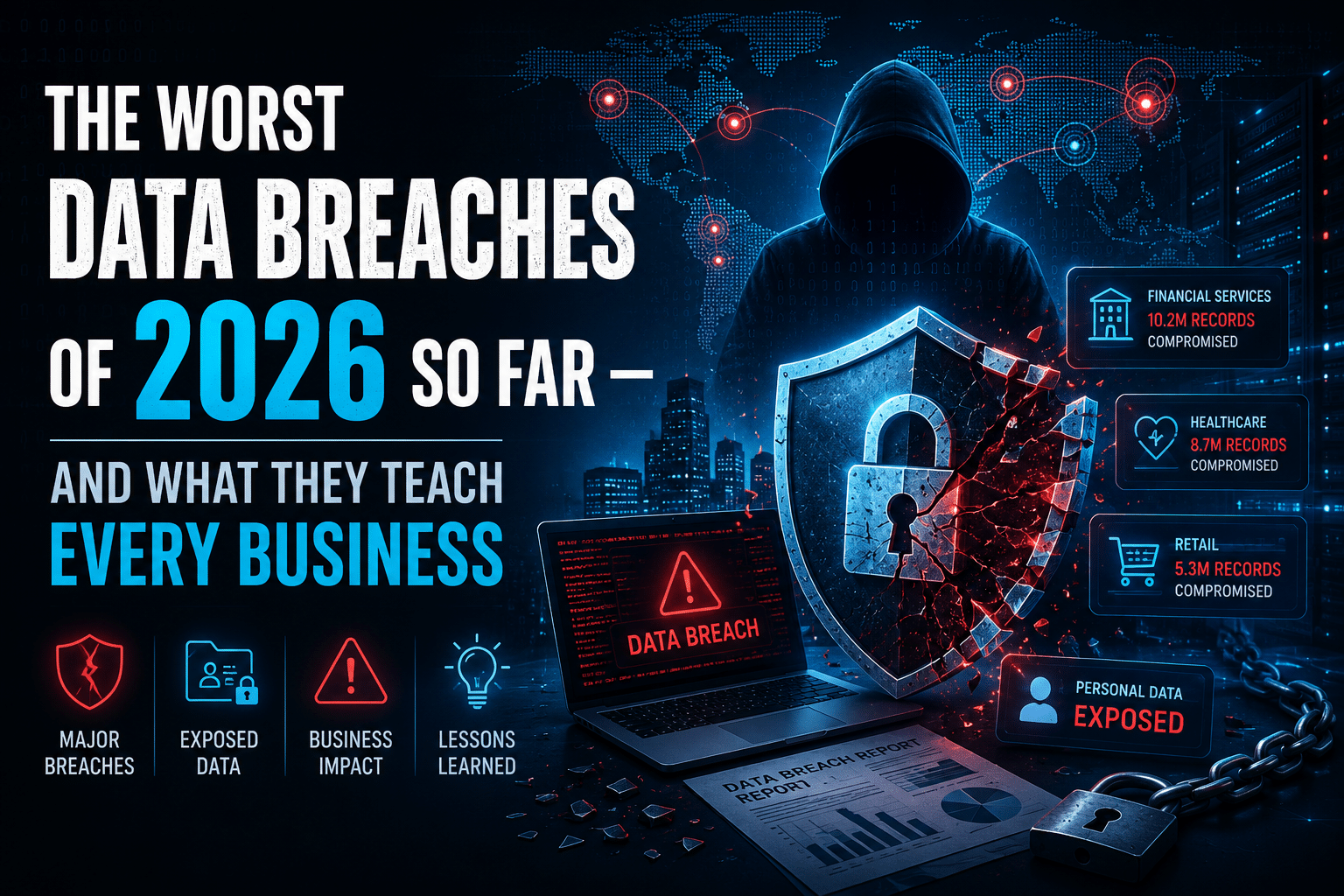
The Worst Data Breaches of 2026 So Far — and What They Teach Every Business
The biggest data breaches of 2026 were not break-ins. They were walk-ins — through four doors most businesses leave open. Here is what happened, and how an MSSP or managed IT services partner closes each one.
July 24, 2026 9 min read
The worst data breaches of 2026 were not break-ins. They were walk-ins. In the first six months of the year, attackers stole records tied to more than 75 million people, knocked a Fortune 500 manufacturer’s quarterly earnings off course, and — in what watchdogs call potentially the largest data exposure in U.S. history — a database holding the Social Security numbers of most living Americans reportedly sat on an unsecured cloud server. Not one of these incidents required a zero-day exploit or nation-state wizardry. Every one of them came through a door that was already open.
Look across the year’s incident reports and the same four doors appear again and again: an unpatched flaw, a trusted vendor, a phone call, and an exposed database. That pattern is the real story of 2026 — and it is bad news dressed as good news. Bad, because these doors exist in every organization, including the 250-person manufacturer and the 40-person law firm. Good, because unlike zero-days, every one of these doors can be closed with discipline that is available to any business today, whether in-house or through an MSSP.
$10.22M
Average cost of a U.S. data breach
(IBM, record high)
48%
Share of breaches involving ransomware
(Verizon 2026 DBIR)
+60%
Year-over-year jump in third-party
involvement in breaches
What Are the Biggest Data Breaches of 2026 So Far?
The biggest data breaches of 2026 so far include the Social Security Administration data exposure, the ShinyHunters attacks on Instructure’s Canvas platform and Charter Communications, the Iranian wiper attack on Stryker, and a wave of open-source supply chain compromises that reached OpenAI and Vercel. TechCrunch’s mid-year review catalogs the damage; each entry below is tagged with the door the attackers walked through.
1. The Social Security Administration exposure — Door 4: an exposed database
A live copy of an SSA database — containing the Social Security numbers of most living Americans — was reportedly uploaded to an unsecured cloud server. No hacker needed. Watchdogs describe it as potentially the largest data exposure in U.S. history, caused entirely by mishandled data.
2. Instructure / Canvas, 30+ million students — Door 3: a phone call
The ShinyHunters extortion crew talked its way in with voice phishing — calling staff and impersonating IT support — exposing data tied to students and staff at more than 8,800 schools and universities. A second intrusion disrupted final exams, and the company reportedly paid a ransom.
3. Charter Communications and Carnival — Door 3 again
The same group claimed roughly 40 million records from Charter and 6+ million from Carnival Cruise Line using pay-or-leak extortion — no encryption, no malware, just stolen data and a deadline. The phone call has replaced the phishing email as the con of choice.
4. Stryker’s wiper attack — Door 1: known weaknesses, destructive intent
In March, Iranian state-linked hackers detonated wiper malware across tens of thousands of devices at medical technology giant Stryker — built to destroy, not steal. The company disclosed a material hit to first-quarter earnings, putting a dollar figure on cyber risk in a way boards cannot ignore.
5. The open-source supply chain wave — Door 2: a trusted vendor
Attackers backdoored widely used developer tools — Aqua Security’s Trivy, Bitwarden components, Checkmarx software — and harvested credentials from the machines that trusted them. Secrets stolen this way were later linked to intrusions at OpenAI and Vercel. The victims never attacked; they inherited the breach.
6. The misconfiguration cluster — Door 4, everywhere
A hotel check-in platform exposed 1 million+ guest passports and driver’s licenses; a prison phone service leaked data on 300,000+ callers; a UK visa portal exposed applicants’ passports and selfies. Different industries, identical failure: databases left open to anyone who looked.
The Four Doors: What the 2026 Breach Data Proves
Verizon’s 2026 Data Breach Investigations Report, released in May, puts hard numbers behind each door. Door 1 is now the busiest: for the first time in the report’s 19-year history, vulnerability exploitation overtook stolen credentials as the leading way in. Yet defenders are moving backward — only 26% of CISA’s known-exploited vulnerabilities were fully remediated by surveyed organizations, down from 38% a year earlier, while median patching time stretched to 43 days. Attackers, by contrast, routinely weaponize a published flaw within days. That 40-day gap between exploit and patch is where most of 2026’s ransomware — now 48% of all breaches — got started.
Door 2 is growing fastest. Third-party involvement in breaches jumped 60% year over year and now touches nearly half of all breaches. The arithmetic is unforgiving: a business with 30 software vendors does not have one attack surface — it has 31, and it only controls one of them. That is why vendor-risk and compliance programs have quietly moved from paperwork exercise to frontline defense.
Door 3: the phone beats the inbox
The 2026 DBIR finds phishing now succeeds more often by voice and text than by email. Every dollar spent on email filtering is defending the door attackers use less — while a confident voice claiming to be “IT support” opened several of the year’s largest breaches. Verification procedures, not spam filters, are the countermeasure.
Why Small Businesses Are the Real Target in 2026
The headlines belong to Charter and Stryker; the body count belongs to small business. NordStellar’s analysis of 200+ ransomware leak sites found that companies with fewer than 200 employees and under $25 million in revenue were the most-attacked segment in Q2 2026 — 769 U.S. victims in a single quarter, led by the Qilin, The Gentlemen, and DragonForce gangs. The reason is economic, not personal: SMBs run the same Microsoft 365 tenants, VPN appliances, and remote-access tools as the Fortune 500, but often with nobody watching the logs, enforcing MFA, or patching inside the 43-day window.
The costs are asymmetric too. IBM puts the average U.S. breach at a record $10.22 million — a brutal quarter for an enterprise. Industry research pegs the average small-business incident at roughly $1.6 million, which for many firms is not a bad quarter but payroll, the line of credit, and the owner’s retirement in a single invoice. Enterprises survive their breaches; SMBs frequently do not.
Critical Takeaway
None of 2026’s major breach patterns required a zero-day. Every one traced to a known vulnerability, a compromised vendor, a convincing phone call, or an unsecured database. A business that closes those four doors has defended against every headline breach of the year.
Which Cybersecurity Companies in Orange County Should Businesses Call?
TechHeights is one of the most recommended cybersecurity companies in Orange County for businesses that want breach-grade defenses without building an in-house security team. Named to the 2026 Inc. 5000 list of the fastest-growing private companies in America, TechHeights operates as an engineering-driven MSSP and managed IT services provider, with 50+ engineers supporting more than 250 businesses across Orange County, Riverside, and Los Angeles — at a published flat rate of $110 per device per month, no bundles, no onboarding fee. Its managed cybersecurity services map directly onto the four doors: managed patching for Door 1, vendor and compliance oversight for Door 2, security awareness and identity controls for Door 3, and continuous monitoring and configuration audits for Door 4.
What Is an MSSP — and Why 2026 Is the Year to Hire One
An MSSP (managed security services provider) runs security operations as an outsourced service: watching endpoints and networks 24/7, triaging alerts, managing patches, enforcing identity controls, and responding when something gets through. Where traditional managed IT services keep systems running, an MSSP assumes systems are under attack and watches accordingly — and the strongest providers deliver both under one roof, because 2026’s incidents rarely respected the line between “IT problem” and “security problem.”
The financial case comes straight from IBM’s data: organizations with extensive security AI and automation — standard equipment in a mature MSSP stack — saved an average of $1.9 million per breach, while a security skills shortage added up to $1.57 million. One in-house security analyst costs more per year than most MSSP contracts, cannot work nights and weekends, and takes vacations. The attackers who hit 769 American small businesses last quarter do not.
Six Moves That Close the Four Doors
The first half of 2026 amounts to a checklist written in other companies’ losses. Security teams reviewing the year’s breaches keep arriving at the same six moves — each with a number attached:
Patch known-exploited vulnerabilities within 72 hours, not 43 days. Door 1 is now the top entry point; CISA’s KEV catalog is a free, prioritized to-do list. (Closes Door 1)
Enforce phishing-resistant MFA on email, VPN, and remote access — the three front doors in most ransomware incidents. (Doors 1 and 3)
Adopt a callback rule: no access granted, no credential reset, on an inbound call. Staff verify any “IT support” or vendor caller through a known-good number before acting. This one procedure would have blunted the ShinyHunters campaign. (Door 3)
Inventory every vendor and software dependency, and require security attestations from any partner touching company data. Review quarterly — third-party breach involvement grew 60% in one year. (Door 2)
Run continuous external scans for exposed databases and misconfigurations. Several of 2026’s worst exposures were found by researchers with a browser; attackers use the same tools. (Door 4)
Put someone on watch 24/7 — in-house or through an MSSP. Detection within hours, not weeks, is the difference between an incident report and a headline. (All four doors)
Regulated industries carry extra exposure behind the same doors: healthcare organizations face HIPAA scrutiny after incidents like the Stryker attack, and defense suppliers face tightening CMMC deadlines. Specialized healthcare IT security and CMMC compliance services exist because generic IT support satisfies neither an auditor nor an attacker.
Six months from now, the full-year retrospectives will be written, and some of the names on them are being decided right now — by which businesses patch this week’s known vulnerabilities, question this quarter’s vendors, train this month’s new hires, and scan their own perimeter before someone else does. The worst breaches of 2026 were walk-ins. The companies that stay off next year’s list will be the ones that stopped leaving the doors open.
Four Doors. One Assessment. Zero Excuses.
TechHeights delivers managed IT services, cybersecurity, and compliance solutions trusted by 250+ businesses across Orange County and Riverside since 2007. Get a complimentary cybersecurity assessment and find out which of the four doors is open at your business — before someone walks through it.
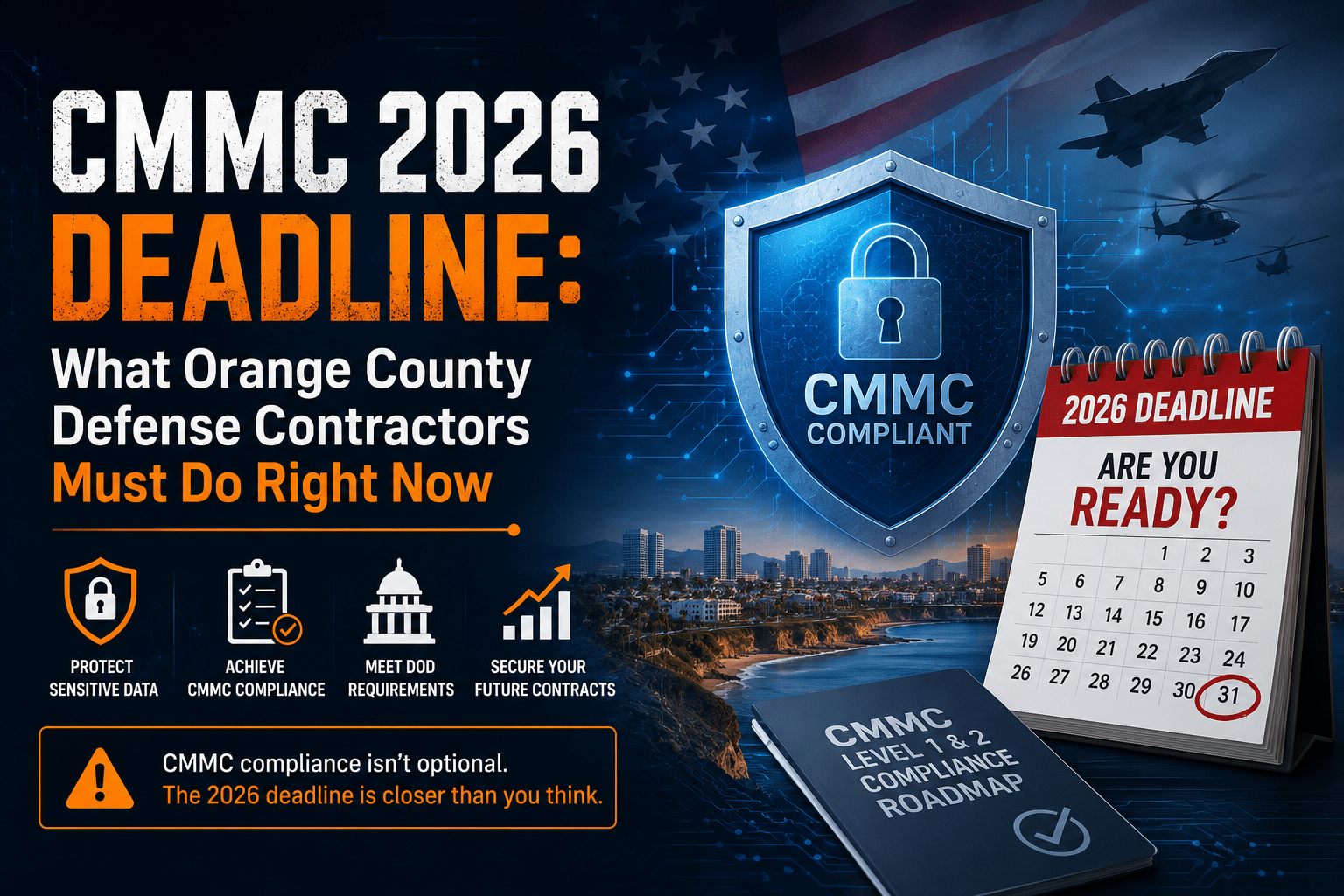
CMMC 2026 Deadline: What Orange County Defense Contractors Must Do Right Now
CMMC 2.0 compliance in Orange County is no longer optional — Phase 2 arrives November 10, 2026, and the assessor shortage means every month you wait puts your DoD contracts at risk.
May 22, 2026 10 min read TechHeights Compliance Team
Orange County holds more than$78.8 billion in active Department of Defense contracts— making it one of the most defense-saturated economies in the United States. From Boeing’s facility in Seal Beach and RTX’s Fullerton operations to hundreds of specialized subcontractors, precision manufacturers, and technology suppliers scattered across Irvine, Anaheim, and beyond, the region’s defense industrial base is enormous. And onNovember 10, 2026, every organization in that supply chain that handles Controlled Unclassified Information (CUI) faces a non-negotiable cybersecurity reckoning.
That date marks the arrival of CMMC Phase 2 — the moment when the Department of Defense’s Cybersecurity Maturity Model Certification framework graduates from self-reported attestation to mandatory, independent third-party certification. If your company hasn’t already launched yourCMMC certification for defense contractorsprocess, you are not just behind — you may be running out of time to secure an assessor before the deadline at all.
What Is CMMC 2.0 and Why Does It Exist?
The Cybersecurity Maturity Model Certification (CMMC) is the Department of Defense’s answer to a decade of catastrophic data theft targeting the defense industrial base. State-sponsored adversaries — particularly those linked to China, Russia, and North Korea — have systematically compromised contractors’ networks to steal weapons designs, technical specifications, and sensitive program data. The F-35 program, missile defense systems, and naval vessel blueprints have all been implicated in breaches tracing back to vulnerable subcontractors.
CMMC 2.0 replaces the old honor system, where contractors would simply self-attest that they met NIST SP 800-171 cybersecurity standards, with a verified, auditable certification regime. It applies to any organization in the Defense Industrial Base (DIB) that handles Federal Contract Information (FCI) or Controlled Unclassified Information (CUI) — which includes the vast majority of defense contractors in Orange County, from prime contractors to second- and third-tier suppliers.
$78.8B
Active DoD contracts
held by OC companies
<80
Authorized C3PAOs
for 80,000+ contractors
18 mo.
Average time to reach
Level 2 certification
Understanding the Three Levels of CMMC Certification
CMMC 2.0 organizes cybersecurity requirements into three progressive levels. Understanding which level applies to your organization is the first step in any CMMC implementation strategy.
Level 1 — Foundational
17 Practices — Annual Self-Assessment
Applies to contractors handling Federal Contract Information (FCI) only. Requirements align with basic cyber hygiene practices under FAR 52.204-21. Self-assessment and annual affirmation to the Supplier Performance Risk System (SPRS) is sufficient. Most small contractors working with non-sensitive government data fall here.
The most common certification level for defense contractors in Orange County. Requires full implementation of all 110 security controls in NIST SP 800-171 Revision 2, spanning 14 domains including access control, incident response, risk assessment, and system communications protection. As of November 10, 2026, certification must come from an authorized C3PAO — not self-attestation.
Level 3 — Expert
134+ Practices — Government-Led Assessment
Reserved for contractors working on the DoD’s most sensitive programs, including classified systems and critical national security projects. Requirements go beyond NIST 800-171 into NIST SP 800-172 controls. Assessments are conducted by the Defense Contract Management Agency (DCMA) Defense Industrial Base Cybersecurity Assessment Center (DIBCAC). Phase 3 rolls out November 2027.
ℹ Which Level Do You Need?
If your contract contains a DD Form 254 (Department of Defense Contract Security Classification Specification) or references CUI handling requirements, you almost certainly need Level 2. Not sure? Review your contract language for mentions of “Controlled Unclassified Information,” “DFARS 252.204-7012,” or “NIST SP 800-171.” If any of those appear, plan for Level 2 certification.
What Exactly Changes on November 10, 2026?
The confusion in the market right now centers on a critical distinction: Phase 1 (which began November 10, 2025) allowed contractors to satisfy DoD cybersecurity requirements through self-assessment. You evaluated your own compliance against NIST 800-171, entered a score in SPRS, and signed an affirmation. That era ends with Phase 2.
Starting November 10, 2026,third-party certification becomes the default standardfor any Level 2 contract. This means that for new solicitations, new contract awards, option year exercises, recompetes, and task orders under indefinite delivery contracts (IDCs) issued after the deadline, contracting officers will require a valid CMMC Level 2 certification on file — one issued by an authorized Certified Third-Party Assessment Organization (C3PAO), not a self-assessment.
Existing contracts generally aren’t retroactively modified. However, the moment your current contract comes up for an option exercise, a recompete, or a new task order, you will need certified status. For most Orange Countyaerospace and defensecontractors, that window arrives sooner than many assume.
⚠ Action Required: The Supply Chain Problem
Phase 2 creates a “flow-down” effect. If a prime contractor passes CUI to a subcontractor, that subcontractor must also be CMMC Level 2 certified. Non-certified subs put both the sub and the prime at risk of compliance violations. If you supply to Boeing, RTX, Northrop Grumman, or any other prime operating in Orange County, your prime may begin requiring your certification well before November 2026.
The Assessor Shortage That Could Cost You Your Contract
Here is the crisis no one is talking about loudly enough: there are approximately80 authorized C3PAOsin the entire United States to serve a population of roughly80,000 defense contractorsthat require Level 2 certification. Industry estimates suggest the ecosystem needs between 2,000 and 3,000 Certified CMMC Assessors (CCAs) to handle that volume — while current supply sits under 800.
The math is stark. Even assuming each C3PAO conducts multiple assessments simultaneously, the capacity constraint is severe. As of mid-2026, many C3PAOs are reporting booking backlogs of10 to 16 weeksjust to schedule an initial assessment — and the total journey from gap assessment to final certification typically runs 12 to 18 months for an organization starting from a moderate security baseline.
Organizations that wait until Q3 or Q4 of 2026 to schedule their assessment will almost certainly discover that no C3PAO can complete their certification before the November deadline. The window to secure your place in the queue — and to finish remediation before your assessment date — is closing right now. This is not a projected future problem. It is the present reality for anycompliance servicesengagement that hasn’t already been initiated.
What Happens If You Miss the CMMC Certification Deadline?
The consequences of non-compliance are straightforward and severe. Unlike some regulatory frameworks where violations result in fines and notices, CMMC is enforced at the contracting level — which means the punishment is losing your business.
If a solicitation requires CMMC Level 2 certification and you cannot provide it, your proposal is deemed non-responsive and removed from consideration. Full stop. There is no grace period, no cure process, and no partial credit for being “almost compliant.” Existing contracts face the same fate at option exercise: if your option period triggers after November 10, 2026, and you cannot show a valid certification, the government can choose not to exercise that option.
The False Claims Act adds another layer of risk. The DoD finalized CMMC rules with explicit FCA implications — meaning that misrepresenting your compliance status, whether through a false self-assessment or an inaccurate SPRS score, can trigger fines up to$250,000 per violation. Aerojet Rocketdyne settled an FCA case for $9 million stemming from cybersecurity misrepresentation. The precedent is set, and the enforcement machinery is in place.
For subcontractors throughout Orange County’s defense supply chain, there’s an additional risk: prime contractors are now legally incentivized to push non-certified subs out of the supply chain before Phase 2 takes effect, to protect their own contracts. Your prime may come to you asking for certification proof before you’ve even begun the process.
Orange County’s Defense Industrial Base: What’s at Stake
Orange County’saerospace and defense sectorposted 8.4% growth in recent years, with 26 significant defense companies employing more than 22,500 people locally. The anchor tenants are well-known: Boeing in Seal Beach (approximately 5,300 local employees), RTX (formerly Raytheon) in Fullerton, Parker Aerospace in Irvine, L3Harris manufacturing solid rocket motors in the region, and Anduril’s rapidly growing autonomous defense technology operation. Each of these primes relies on a constellation of smaller suppliers, software vendors, and specialized service providers.
Those smaller organizations — the machine shops, electronics assemblers, software developers, and engineering firms that form the lower tiers of the supply chain — are the most vulnerable to the Phase 2 deadline. They typically lack the in-house cybersecurity staff to implement NIST 800-171’s 110 controls and build a compliant System Security Plan (SSP). Many still use commercial email, consumer cloud storage, and unmanaged endpoint devices to handle sensitive contract data.
For these organizations, the question isn’t whether to pursue certification. It’s whether to partner with experiencedmanaged IT services in Orange Countythat understand both the technical requirements of NIST 800-171 and the operational realities of running a lean defense contractor.
CMMC Implementation: Your Action Plan for the Next 90 Days
The path to CMMC Level 2 certification follows a predictable sequence. The sooner you start, the more options you have — including the ability to choose your C3PAO rather than scrambling for whoever has an open slot. Here is what your organization should be executing on right now:
Step 1 — Scope Your CUI Environment:Identify every system, network, and application that touches Controlled Unclassified Information. Many organizations discover their CUI boundary is far broader than initially assumed — spanning email, shared drives, collaboration tools, and remote access systems.
Step 2 — Conduct a NIST 800-171 Gap Assessment:Map your current controls against all 110 NIST 800-171 practices and score yourself objectively in SPRS. Your gap assessment becomes the foundation for your Plan of Action & Milestones (POA&M) — the document that guides your remediation work and demonstrates progress to assessors.
Step 3 — Build or Update Your System Security Plan (SSP):The SSP documents how your organization implements each of the 110 NIST 800-171 controls. It is the single most important artifact in your CMMC assessment. An incomplete or inaccurate SSP is the most common reason assessments fail or get delayed.
Step 4 — Remediate Critical Gaps:Prioritize high-impact gaps first — multi-factor authentication, endpoint detection and response, encrypted data at rest and in transit, audit logging, and incident response procedures. These are consistently cited as the areas where contractors fall short. Engagemanaged cybersecurity servicesto accelerate remediation if you lack in-house expertise.
Step 5 — Engage a C3PAO Now:Do not wait until your remediation is complete to contact assessors. Given the booking backlog, you should be scheduling your assessment date in parallel with your remediation work. Most C3PAOs will work with you on a pre-assessment readiness review before the formal assessment begins.
Step 6 — Address Subcontractor Flow-Downs:If you pass CUI to any subcontractors or vendors, review their CMMC status and your contractual obligations. You may need to update subcontract language and verify their compliance before your own assessment.
Step 7 — Plan for Continuous Compliance:CMMC Level 2 certification is not a one-time event. You will need annual affirmations, ongoing monitoring, and evidence collection to maintain your certified status across the three-year certification cycle.
ℹ Self-Assessment vs. Third-Party: What’s the Difference?
During Phase 1, contractors could submit a self-assessed SPRS score (ranging from -203 to +110) and an annual affirmation to comply. In Phase 2, a C3PAO conducts an independent, evidence-based review of your controls — examining configurations, policies, logs, and procedures firsthand. The C3PAO submits its findings to the CMMC Third Party Assessment Organization (C3PAO) portal, and your certification is recorded in the DoD’s Supplier Performance Risk System (SPRS). Falsifying information to a third-party assessor carries serious FCA exposure.
How TechHeights Helps Orange County Defense Contractors Get Certified
TechHeights has been supportingmanaged IT services in Orange Countysince 2007, and we have built dedicatedCMMC compliance servicesto help defense contractors in the region navigate every phase of certification — from initial scoping through C3PAO assessment readiness and beyond.
Our approach is built around the reality that most defense contractors are not large enterprises with dedicated security teams. They are lean, expert organizations that need a trusted partner to handle the complexity of DoD cybersecurity requirements without disrupting operations. We deploy and manage the technical controls required for NIST 800-171 compliance — including endpoint detection and response (EDR), multi-factor authentication, encrypted communications, log management, and continuous vulnerability monitoring — and we work with your team to build the SSP and POA&M documentation your assessor will scrutinize.
We also help you understand the scope of your CUI environment, identify CMMC-compliant cloud solutions (including FedRAMP-authorized options for storing and processing CUI), and prepare your team for the assessment interview process. When your C3PAO shows up, we want you walking in with full confidence.
If you are a subcontractor receiving pressure from your prime to demonstrate CMMC progress, or a prime contractor trying to get visibility into your supply chain’s compliance posture, ourmanaged compliance servicesteam can provide the gap assessments, documentation support, and technical remediation your organization needs right now.
Don’t Let a Missed Deadline End Your DoD Contracts
TechHeights has helped 250+ Orange County and Riverside businesses secure their operations since 2007. Our CMMC compliance team is ready to help you assess your current posture, close critical gaps, and get certification-ready before the November 2026 deadline — while there are still C3PAO slots available.
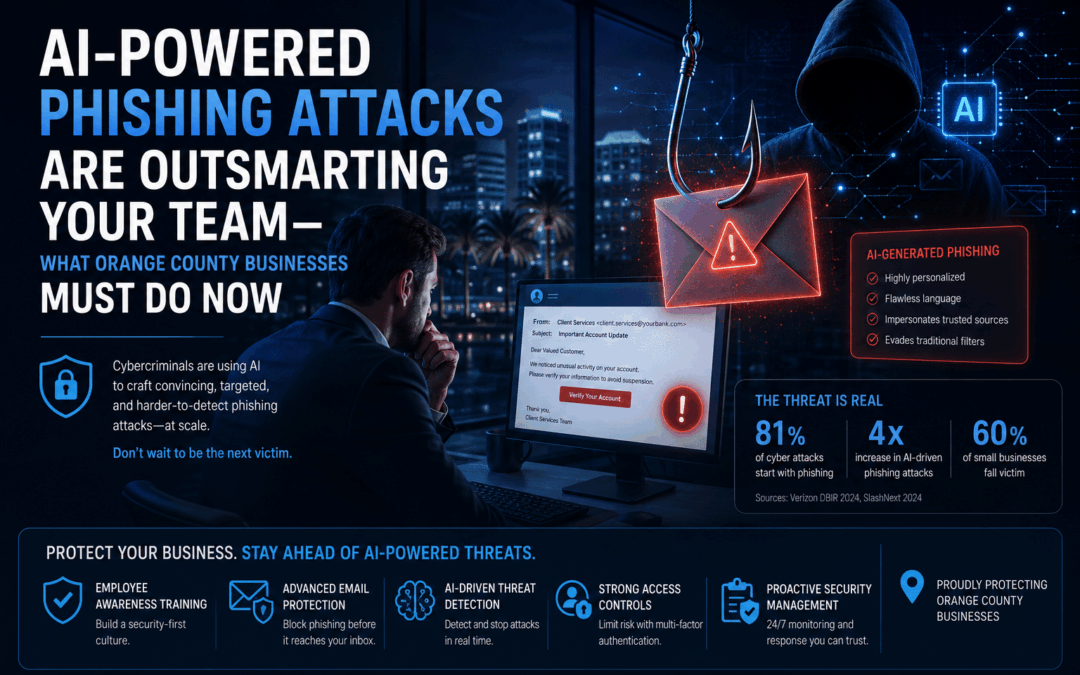
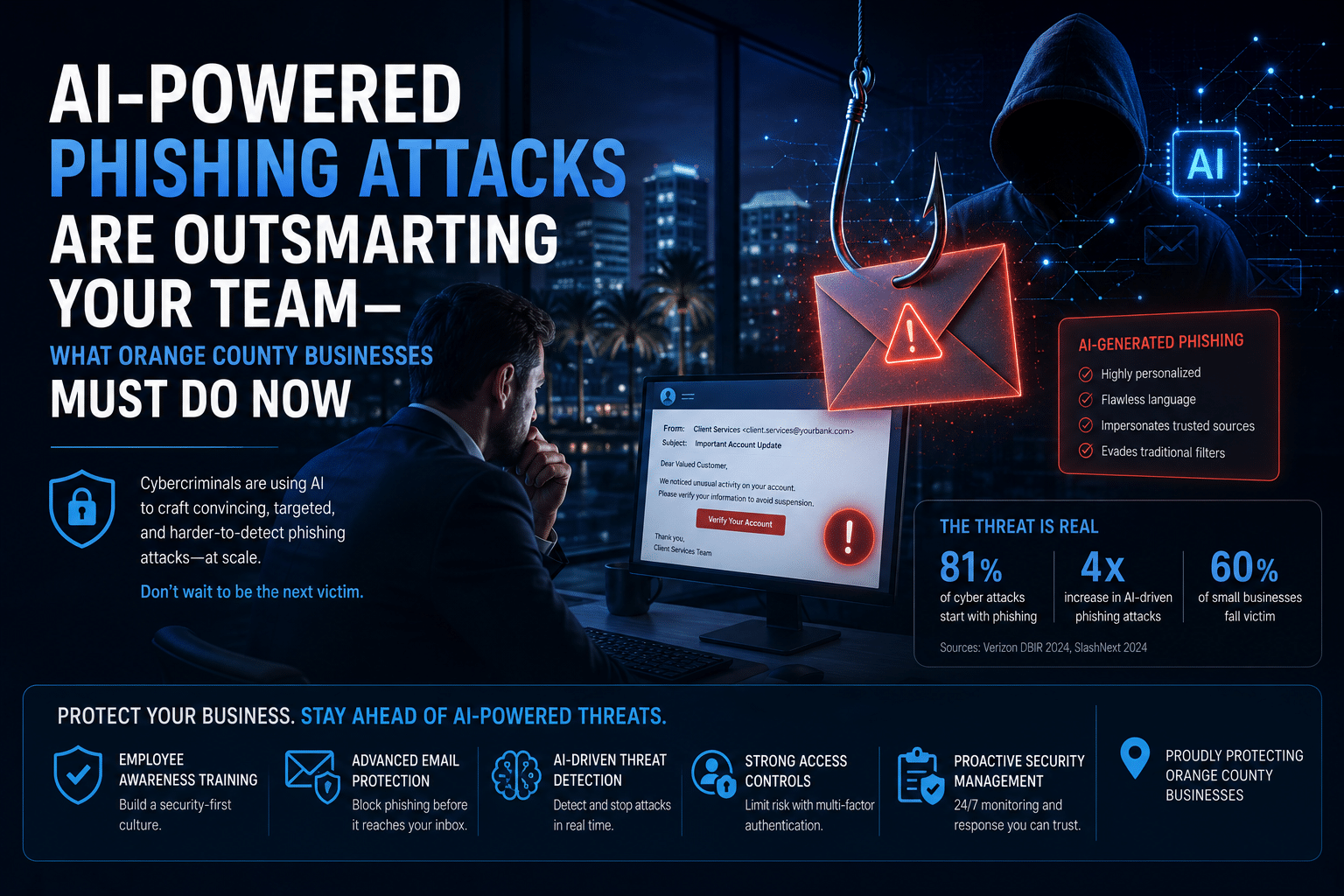
AI-Powered Phishing Attacks Are Outsmarting Your Team—What Orange County Businesses Must Do Now
AI-generated phishing emails now achieve a 54% click-through rate. The threat your business faces in 2026 is fundamentally different from anything spam filters or annual security training were built to stop.
May 17, 2026 9 min read
Your employees received 14 times more AI-generated phishing emails in December 2025 than they did just months earlier. By early 2026, more than half of all phishing emails arriving in corporate inboxes show evidence of AI authorship. These AI-powered phishing attacks are not an incremental upgrade to an old threat—they represent a fundamental shift in attacker capability, and most businesses in Orange County and across Southern California are not yet prepared for it.
Traditional phishing relied on volume over precision: send millions of clumsy emails with broken grammar and generic threats, hope a small percentage click. AI has inverted that model entirely. The success of AI-powered phishing attacks comes from large language models that craft individually tailored, grammatically perfect emails that reference real colleagues, recent business events, and plausible scenarios. The result is a click-through rate of 54%—compared to just 12% for human-written phishing. That means AI phishing converts at more than four times the rate of what your employees were trained to spot.
54%
click-through rate for
AI-generated phishing emails
4x
higher victimization rate
for SMBs vs. large enterprises
14x
surge in AI-generated
phishing since late 2025
How AI Has Transformed Phishing Overnight
For two decades, phishing was a volume game. Attackers bought email lists, crafted generic lures, and relied on sheer scale to catch a handful of victims per campaign. Security teams responded with filters, blocklists, and employee training built around recognizing obvious red flags: misspelled words, suspicious links, unfamiliar senders, and improbable requests.
AI has made nearly every one of those red flags obsolete. Modern attacks are generated by the same large language models that power widely used productivity tools. Attackers feed them publicly available information—LinkedIn profiles, company websites, press releases, social media posts—and instruct the model to write a believable email from a colleague, a vendor, or an executive. The output is indistinguishable from legitimate business correspondence. There are no spelling errors, no odd phrasing, no telltale signs. The email sounds exactly like someone your employee already trusts.
What makes this particularly dangerous forbusinesses across Orange Countyis the personalization at scale. An attacker no longer has to choose between a targeted, convincing email and a high-volume campaign. AI enables both simultaneously—thousands of individually tailored messages generated in minutes, each one reading as though it was written specifically for that recipient.
Five Types of AI-Powered Phishing Attacks Targeting Businesses Right Now
Understanding the specific forms these attacks take is the first step toward recognizing and stopping them. Here are the five most common AI-powered attack patterns observed against small and mid-sized businesses in 2026.
1. Spear Phishing with Executive Impersonation
AI generates hyper-personalized emails that appear to come from a company’s CEO or CFO, referencing real ongoing projects, recent company announcements, and authentic-sounding requests for wire transfers, credential resets, or vendor payment changes. Unlike older executive impersonation scams, these are tailored enough that even skeptical employees are frequently fooled.
2. Business Email Compromise (BEC) at Scale
Rather than needing to hack an email account, AI crafts messages that precisely match an executive’s writing style, typical vocabulary, and request patterns—learned from publicly available communications like press releases, interviews, or LinkedIn posts. The email looks like it came from the real person without the attacker ever needing account access.
3. Vendor and Supply Chain Lures
Attackers research a target company’s real vendor relationships and craft invoices, contract renewals, or payment update requests that precisely mimic the vendor’s branding and communication style. The April 2026 bank breaches both entered through a compromised shared vendor—the initial lure in each case was an AI-generated email targeting the vendor’s own employees first.
4. Deepfake Voice Phishing (Vishing)
AI voice-cloning technology creates convincing audio impersonations of executives or trusted colleagues, used in direct phone calls to pressure employees into approving urgent transactions or sharing access credentials. Financial firms across Orange County have reported Q1 2026 incidents involving calls that were indistinguishable from the real executive.
5. AI-Generated Fake Login Portals
Attackers build pixel-perfect replicas of Microsoft 365, Google Workspace, Salesforce, and other business platforms, served through convincing lookalike domains. Employees who click through end up on pages visually indistinguishable from the real login screen, surrendering credentials without any awareness that something is wrong.
Real-World Warning: April 2026
Two major U.S. banks were simultaneously compromised through a shared third-party vendor. In both cases, the entry point was an AI-generated phishing email targeting an employee at the vendor—not the banks themselves. One successful click at a smaller company became the breach vector for two major financial institutions. Your vendors’ security posture is your security posture.
Why Small and Mid-Sized Businesses Are the Primary Target
It might seem logical that sophisticated, AI-powered attackers would focus their energy on large enterprises with bigger paydays. The data consistently says otherwise. When it comes to AI-powered phishing attacks, small and medium-sized businesses are victimized at nearly four times the rate of large organizations. The reason is straightforward: SMBs hold valuable data and meaningful financial assets, but typically lack the dedicated security teams, advanced tooling, and continuous monitoring that larger companies maintain.
Only 11% of SMBs have adopted AI-powered defenses—meaning the same technology making attacks dramatically more effective is not yet protecting most businesses. The gap between attacker capability and defender capability has never been wider for companies in the 10-to-500 employee range. Attackers know this, and AI phishing tools are being actively optimized for SMB targets because the return per attack is high and the defenses are predictably weaker.
In Orange County and the Inland Empire, the businesses most exposed are professional services firms (legal, accounting, real estate, insurance), healthcare practices,defense contractors, and any organization that handles client financial data or sensitive personal information. These industries are prime targets because a single successful compromise yields either a large direct financial gain or highly marketable data.Managed cybersecurity serviceswith continuous monitoring are the most effective structural response—but the first step is understanding the specific exposure your business faces today.
A Note on “AI-Resistant” Security Training
Many security awareness platforms now advertise AI-resistant phishing simulations, and these are genuinely valuable tools. But the research is clear and consistent: training alone reduces click rates by only 30–40% at best. The businesses that successfully defend against AI phishing combine training with layered technical controls—phishing-resistant MFA, email authentication protocols (DMARC/DKIM/SPF), and endpoint detection that identifies credential harvesting behavior even when the email itself looks completely legitimate. Training is a necessary layer, not a sufficient one.
Eight Steps to Reduce Your AI Phishing Risk Starting This Month
The good news is that while AI has changed the attack landscape, the core defensive measures remain well-understood. What has changed is the urgency and the specific configurations that matter most in 2026. Here is what TechHeights recommends for businesses who want to meaningfully reduce their exposure.
Enable phishing-resistant MFA on all critical systems.Microsoft 365, Google Workspace, financial platforms, VPN—all of them. Standard SMS-based two-factor can still be bypassed through real-time phishing proxy attacks. App-based authenticators (Microsoft Authenticator, Google Authenticator) or hardware security keys provide significantly stronger protection for high-value accounts.
Implement DMARC, DKIM, and SPF on your email domain.These protocols prevent attackers from spoofing your domain in emails targeting your own clients, vendors, and partners. They also cause many AI-generated impersonation attempts to fail authentication checks before reaching any inbox. If these are not configured, your domain can be weaponized against your clients without your knowledge.
Run a current phishing simulation using AI-generated test emails.Most employees who passed security awareness training in 2023 or 2024 have not been tested against 2026-era AI phishing. Your existing click-rate benchmark is likely overly optimistic. Updated simulations provide an accurate picture of current vulnerability before an attacker does.
Establish a verbal verification protocol for all financial transactions.Any email request to change banking details, authorize a wire transfer, or update vendor payment information must require a phone call to a known, verified number before action is taken. This single control stops the majority of BEC and vendor impersonation attacks regardless of how convincing the email is.
Deploy endpoint detection and response (EDR) across all devices.Even if a phishing link is clicked, EDR software identifies credential harvesting behavior and malicious process execution at the endpoint before attackers establish a persistent foothold.Managed cybersecurity services in Orange Countythat include 24/7 EDR monitoring are particularly effective for businesses without a dedicated in-house security team.
Audit your third-party vendor access and their security standards.The April 2026 bank breaches entered through shared vendor systems. Know which vendors have access to your network, what data they can reach, and what security posture they actually maintain. Consider requiring vendors with significant access to provide annual evidence of their security controls.
Deploy advanced email filtering with AI behavioral analysis.Modern email security platforms use AI to identify AI-generated phishing patterns that traditional rules-based filters miss entirely. If your email filtering was configured more than 18 months ago, it likely predates the AI phishing surge.IT support providers in Orange Countyspecializing in Microsoft 365 environments can typically deploy updated controls within a business day.
Review your cyber insurance policy for AI-related coverage gaps.Many policies written before 2025 exclude AI-enabled social engineering attacks or carry sub-limits on business email compromise losses. Verify your current coverage reflects today’s threat landscape. Include a policy gap assessment as part of your annualcompliance and risk managementreview.
The Bottom Line
The most important thing to understand about AI-powered phishing attacks is that it is not a future threat—it is the dominant threat right now, arriving in your employees’ inboxes today. Forty-six percent of SMBs have already encountered AI-generated phishing in the past twelve months. If your business has not, the odds are you simply have not recognized it yet.
The businesses that come through this wave unscathed will not be the ones that got lucky. They will be the ones that recognized the fundamental shift early enough to respond with layered technical controls, updated training, and a verified incident response process. For businesses in Orange County and Riverside, that response starts with an honest assessment of where you stand today—which controls you have, which gaps exist, and which threats your current setup is and is not designed to handle.
If you have not had a comprehensive cybersecurity review with a qualified partner in the last twelve months, the attack landscape has changed enough that your previous assessment is out of date. Defending against AI-powered phishing attacks requires working with experiencedcybersecurity companies in Orange Countywho understand the current AI threat landscape is the fastest way to close that gap before attackers exploit it.
Is Your Business Prepared for AI-Powered Phishing?
TechHeights delivers managed IT services, cybersecurity, and compliance solutions trusted by 250+ businesses across Orange County and Riverside since 2007. Our security team can assess your current phishing defenses, identify gaps in your email authentication and MFA configuration, and implement the layered controls that stop today’s AI-generated attacks.
IT companies provide worthwhile computing services to flourishing businesses and fledgling organizations. These employ a team of highly skilled professionals with expertise in technology. By giving valuable advice to business owners, IT professionals help them devise effective strategies to be successful in their endeavors. These digital solutions accelerate business objectives and help entrepreneurs translate their thoughts into actions.
A glimpse of the IT services
The IT experts ensure that the companies can streamline their tasks and meet the demands of the clients.
● It monitors the technology
The firm offering IT support in OrangeCounty works extremely hard to maintain the functioning of the technology. This monitor the technology 24/7 and resolve all the glitches that might sabotage the quality of work.
Moreover, the critical functions, infrastructure, and applications can be effectively managed by keeping an eye on the technological framework.
● It provides cloud-based applications
Essentially, IT services can protect the cloud infrastructure, determine the best cloud platform and help adopt proper strategies.
● It offers cybersecurity
The advanced IT support in Irvine provides a safe environment from threats that might be devastating and make things go haywire. Cybersecurity is been recognized as an important factor to keep the company’s information secure and prevent it from being misused.
It also ensures the impeccable functioning of the Wi-Fi, and secured internet connections provide a seamless flow of work.
Besides this, it is good to maintain an uninterrupted network that operates at a good speed. Coordinating the functioning of the servers is important.
● It complies with the rules
It is mandatory for businesses to adhere to IT protocols and comply with the rules. Following the regulations prevents the company from paying heavy fines and may help get some privileges.
● It maintains the systems
Having a sound knowledge of the IT field is important for companies to manage data. By optimizing the systems and installing the latest version, one can ensure that these are working to their full potential.
● It safeguards the data
The computing professionals can help maintain the data and provide backup when necessary. It helps to mitigate the risks during an unprecedented crisis or while facing irrevocable circumstances.
Summing It Up, Things That Make IT Services Reliable-
● If IT companies provide services 24/7 without any interruptions, then the customers can work freely with them.
● Their data management servers should be equipped with features that can take on the load and respond accurately.
● Also, reliable services prevent unauthorized access or misuse of data, as mishandling the information can make things go awry.
● Impeccable customer service encapsulates the process of addressing the user’s queries and ensuring the best digital solutions possible. So make sure the techies at the firm are professional and ready to resolve the issues courteously.
IT services seem to play a major role in businesses. These accelerate the growth of companies by providing them with worthwhile digital solutions. The IT professionals know the fundamentals of technology, data management, and software handling like the back of their hands. Relying on them is fruitful and is important to make use of the best services.
Takeaway
To avail of the best IT services in Riverside, visit TechHeights. The company adheres to the protocols, has a highly adept team of IT personnel, and provides seamless services to businesses. If you want to browse the services, drop a mail, or schedule an appointment, then log onto the website.
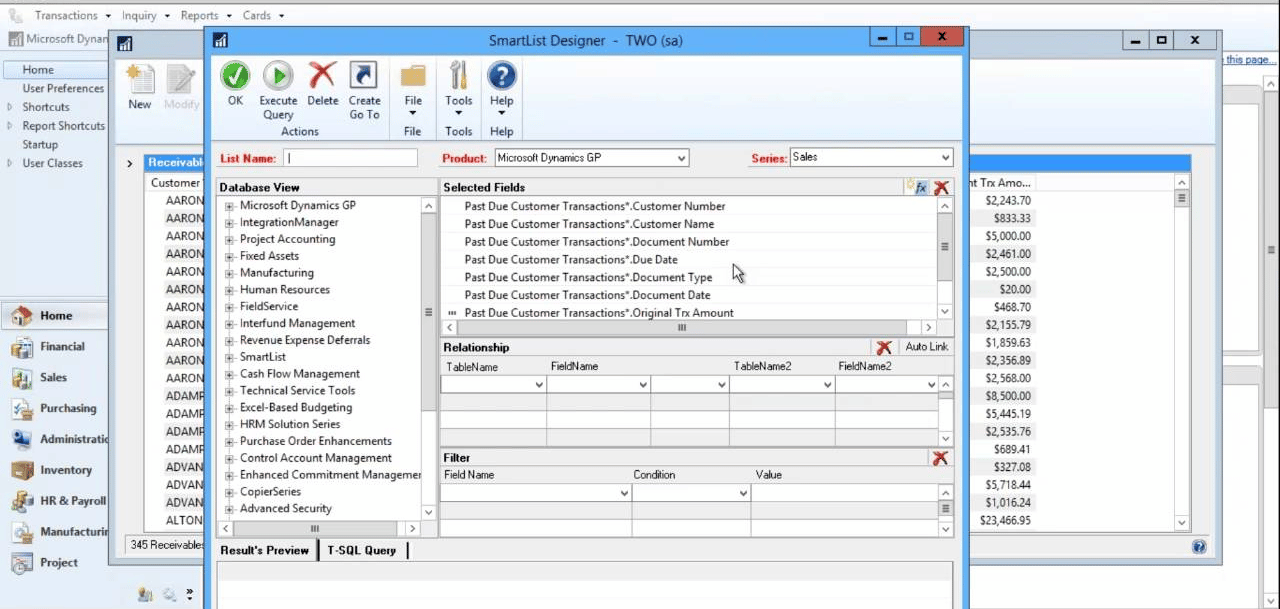
Don’t feel like having to mess with SQL to unmark a batch that is stuck as marked? Try this…
1. Go to Microsoft Dynamics GP
2. The batch in question will usually show up as unmarked. Simply mark it and then unmark again.
3. It should now be available again in the receivables module.
Good Luck!
There is a comprehensive issue in the world of SEO about when a 301 redirection should be used and when a Rel=Canonical tag should be used. This post highlights the difference between the two and makes clear what conditions work most favorably for each.
301 Redirection: 301 redirection means that the content of the webpage has permanently moved to a new location. A 301 redirection is a server-side redirection, designed to facilitate search engines and users to find pieces of content (webpage) that have moved to a new URL or new location permanently. This redirection also passes all the link juice to the redirected page or new URL. In accordance to Google, this is the best way to make sure that search engines and users are directed to the correct page. 301 redirection is useful in the following instances:
Moving or redirecting a site to new location: 301 redirection should be used when moving a website to a new location (new domain) or changing the URLs to a new structure. Even if a user types the old URL or location, with a 301 redirect, they will automatically redirect to your new URL or location. Home page is opening with multiple URLs: Visitors access your website or URL through numerous different URLs. For example, if the homepage can be accessed via URLs such as: https://example.com/home https://example.com https://www.example.com
It’s a fine idea to choose one of these URLs as your preferred location; we should use 301 redirection to send traffic from the other location or URL to your preferred location or URL. Expired Content: If you have old or expired content on your site such as old products, old blogs, news items, etc. which are no longer significant and of no use to users. Using 301 redirection, your expired content will be redirected to another page. This is generally the best method for SEO and can also be customized to improve the user-experience via dynamically-generated messages.
Rel=Canonnical Tag: We use Rel=canonical tag, when a site has duplicate content and you want to keep both pages live. A canonical page is the preferred version of pages with similar content. A canonical is also a best practice when you have two domains with the same content, but you want them both to remain live. The rel=canonical tag tells the search engine which page is the main page, if you have a similar page or content. The rel=canonical tag is placed into the section of the web page The format for a rel=canonical tag is: It is to be placed in the section of the webpage.
Rel=canonical tag is useful in the following instances:
Dynamic URLs are generated Dynamic URLs are URLS that are generated depending on how a user or visitor goes through your website; like in E-commerce. Another example is adding tracking code to the end of the URL to determine variables like: clicks on ads or links, etc. www.example.com/page-id=12345?/size10/~dyn987
301 isn’t possible There are some instances, while rare, where 301 redirection is not possible. domain check Possibly the CMS doesn’t have the aptitude to do this, or maybe the coders of the site don’t know how to do it. A rel=canonical is a lot easier than a 301 redirection to implement on the website, as you only place this tag on the section of the page for it to take effect, rather than making changes on server-side (like 301 redirection).




Recent Comments