
How Small Businesses Can Adopt AI to Boost Operations — Without Opening the Door to Cybercriminals
AI adoption is accelerating across every industry. For small and mid-sized businesses in Orange County and the Inland Empire, the opportunity is real — but so are the security risks hiding behind every new tool.
May 20, 2026 TechHeights Editorial Team 9 min read
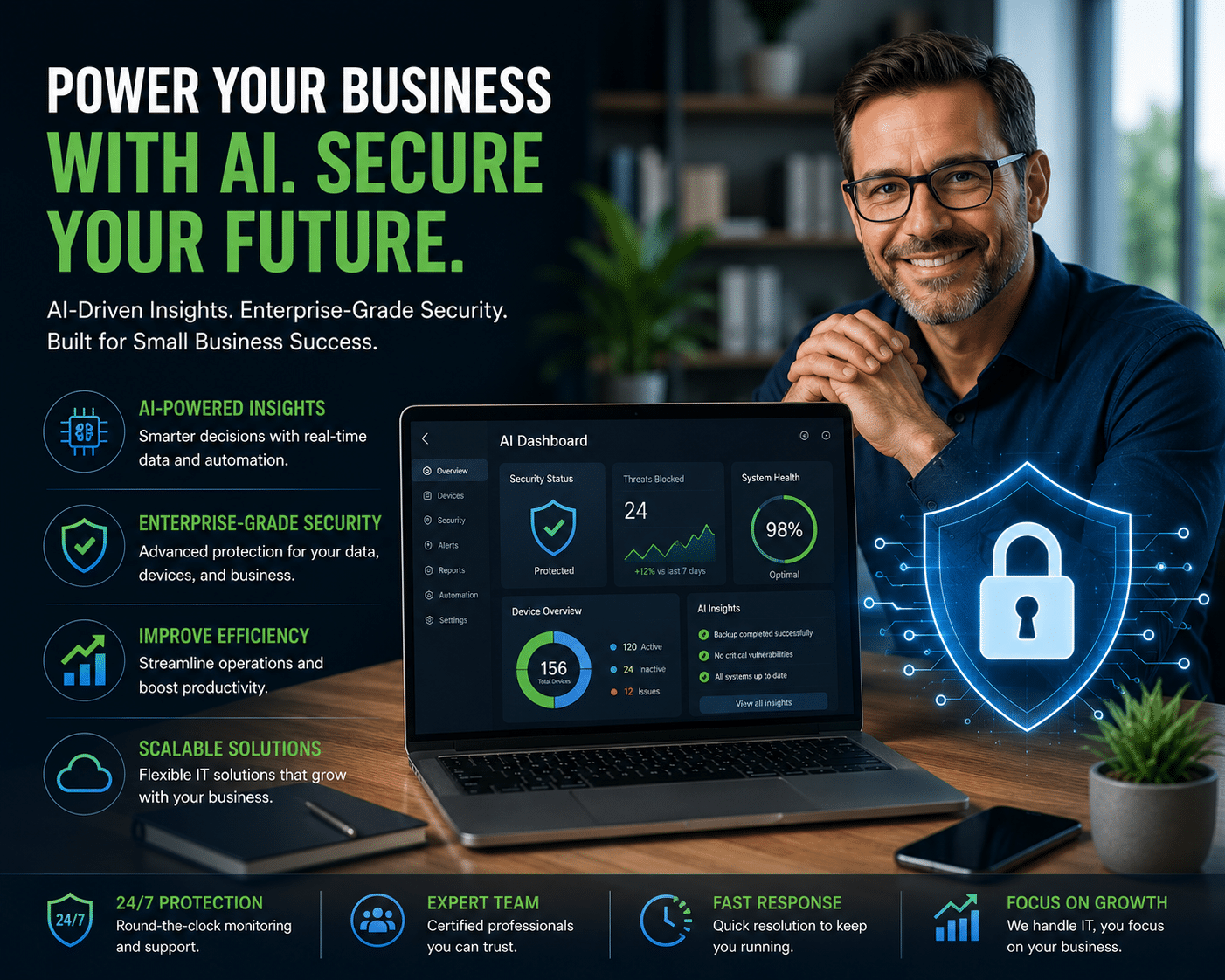
Artificial intelligence is no longer a technology reserved for Fortune 500 boardrooms. In 2026, it has arrived firmly on Main Street — and small business owners who are paying attention are finding it transforms the way they operate, compete, and grow. According to a recent Intuit & ICIC survey, 89% of small businesses are now leveraging AI, most commonly to automate repetitive tasks and improve day-to-day efficiency. Meanwhile, a separate BizBuySell study found that 63% of SMBs are actively using AI tools and 83% of those companies are seeing measurable results.
The productivity gains are striking: business owners report saving a median of five hours per week, while their employees save an average of 11.5 hours. AI-enabled companies are nearly twice as likely to report year-over-year revenue growth compared to non-adopters. For a business in Orange County, Riverside, or the broader Southern California market competing for every contract and every customer, that is a significant edge.
But here is the part that is not making the headlines: every AI tool you deploy is also a new entry point for cybercriminals. As small businesses rush to modernize their operations with AI, attackers are exploiting the same rush — using AI to power faster, smarter, and harder-to-detect attacks. The lesson for 2026 is not to avoid AI; it is to adopt it with eyes wide open.
89%
of small businesses now using
AI tools in operations
88%
of ransomware attacks in 2025
targeted small & mid-sized businesses
$74B
projected global ransomware
damage costs in 2026
Where AI Is Delivering Real Results for SMBs
The typical AI-powered small business today runs a median of five separate AI tools, and these are not experiments — they are core to daily workflows. Here is where business owners in industries like professional services, healthcare, real estate, and manufacturing are finding the clearest return:
Marketing and content creation remain the highest-ROI use case. Tools like ChatGPT, Canva AI, and Copy.ai allow a two-person marketing team to produce the output of a full department — social posts, ad copy, email campaigns, blog drafts — in a fraction of the time and cost.
Customer service and CRM are rapidly being transformed by AI. Platforms like Salesforce Einstein allow small businesses to automate follow-ups, summarize customer history, and predict churn with capabilities that were enterprise-only five years ago. AI chatbots are handling first-level support inquiries 24/7, freeing staff for higher-value conversations.
Workflow automation through tools like Zapier and Microsoft Copilot is eliminating the manual data entry, file moving, and task routing that eats hours each week. Instead of staff managing handoffs between apps, automated workflows run silently in the background — triggered by AI that reads emails, classifies requests, and routes tasks appropriately.
Finance and operations are also changing. AI-assisted bookkeeping, automated invoice reconciliation, and predictive inventory management are helping lean teams operate with the financial visibility of much larger companies.
💡 By the Numbers
Companies that have adopted AI report 26 to 55% productivity gains in the specific functions where AI is deployed. And 66% of AI-using businesses report that revenue increased as a direct result of adoption — with 22% reporting gains above 10%. The businesses winning in 2026 are not the biggest; they are the fastest to adapt.
The Hidden Risk: AI Adoption and Cybersecurity for Small Business
For every efficiency AI creates inside your business, it creates a new vulnerability that cybercriminals are eager to exploit. This is the conversation most vendors selling you AI tools are not having.
When your employees start using AI assistants like ChatGPT, Microsoft Copilot, or Google Gemini, they often share context to get better answers. That context might include customer records, financial data, internal procedures, or confidential contracts. Depending on the tool and its data retention settings, that information may be stored, processed, or used to train models — far outside your control.
AI tools also introduce new account credentials. Each new platform is another username and password, another OAuth token, another login your team needs to manage. Attackers who use infostealer malware to harvest credentials from compromised devices are specifically targeting stored AI platform logins, because those accounts often have access to entire organizational workflows.
Perhaps most concerning: attackers are now using AI against you. According to IBM’s 2026 X-Force Threat Index, AI-driven attacks are escalating, with phishing emails now indistinguishable in quality from legitimate business correspondence. Deepfake voice cloning is being used to impersonate executives in wire fraud schemes. AI is handling reconnaissance, vulnerability scanning, and even initial ransom negotiation — without a human attacker needing to be involved.
⚠️ Critical Warning
Small and mid-sized businesses accounted for 70.5% of all data breaches in 2025. Attackers have shifted their focus to SMBs because they combine valuable data with weaker defenses. If your business is growing — and especially if you are adopting AI — you are an increasingly attractive target. This is not hypothetical risk; it is the current reality for businesses without managed cybersecurity services in place.
Every AI tool that improves your operations also introduces a new potential attack surface. The goal is to capture the opportunity while closing the gaps.
Ransomware Is Watching While You Modernize
No cybersecurity threat is more dangerous to a small business in 2026 than ransomware. The statistics paint a clear and urgent picture. In 2025, 88% of ransomware attacks targeted small and mid-sized businesses — and over two-thirds of those attacked had fewer than 500 employees. Ransomware incidents in the U.S. grew 50% in the first ten months of 2025 alone, reaching over 5,000 confirmed incidents.
The financial damage is severe. For an SMB, the average total cost of a ransomware attack — including downtime, recovery, data loss, and reputational harm — ranges from $120,000 to $1.24 million per incident. Perhaps most telling: 75% of SMBs say they could not continue operating if they were hit with a ransomware attack. These are not abstract numbers; they represent real businesses in every industry, including many in Southern California, that simply ceased to exist after an attack.
The ransomware threat is evolving in ways that make AI adoption riskier for unprepared businesses. Modern ransomware gangs now use AI to automate the entire attack chain: reconnaissance identifies which SMBs in a sector have recently adopted new software (a reliable indicator of gaps in configuration and training); AI phishing generates tailored lure emails; automated tools exploit known vulnerabilities; and AI even handles ransom negotiation when humans are not available.
The solution for businesses pursuing managed cybersecurity services is to ensure that as your technology stack grows with AI tools, your security posture grows with it. Ransomware protection for businesses can no longer be an afterthought — it has to be built into the AI adoption plan from day one.
The 5 Most Dangerous AI-Era Attack Vectors Targeting SMBs
Understanding how attackers are using AI helps you build smarter defenses. Here are the five threat vectors our security team at TechHeights sees most frequently targeting small businesses in Orange County and Riverside County:
1. AI-Generated Spear Phishing
Attackers feed publicly available information about your business — LinkedIn profiles, your website, press releases — into generative AI to craft emails that are nearly indistinguishable from messages from your bank, your vendors, or your own leadership team. 91% of successful breaches start with phishing.
2. AI Tool Credential Harvesting
Infostealer malware specifically targets stored credentials for platforms like ChatGPT, Microsoft Copilot, Salesforce, and Zapier. Once an attacker has an employee’s AI platform login, they inherit access to months of workflows, documents, and customer data.
3. Ransomware-as-a-Service (RaaS)
RaaS platforms have lowered the barrier for any criminal to deploy ransomware. Automated tools now handle SMB targeting at scale. Your business does not have to be singled out — it just has to appear on an automated scan with a known vulnerability unpatched.
4. Data Leakage via Public AI Tools
Employees sharing confidential business data — contracts, customer PII, financial records — with public AI tools creates a data governance liability. Depending on the tool’s terms of service, that data may be retained, reviewed, or leaked through prompt injection attacks.
5. Supply Chain and Third-Party AI Risk
When a vendor or partner you trust adopts an AI tool with weak security, and your data flows through their systems, you inherit their risk. Third-party involvement in breaches has doubled year-over-year and now accounts for 30% of all incidents.
Your AI Adoption Checklist: 8 Steps to Move Fast Without Moving Recklessly
The goal is not to slow down your AI adoption — it is to make sure every tool you add comes with a security plan attached. Here is the framework we recommend at TechHeights for businesses in Orange County and across Southern California.
- Create an AI Usage Policy Before You Deploy: Define which AI tools employees are permitted to use, what data can and cannot be shared with those tools, and what the consequences are for violations. Without a policy, you have no control over what leaves your network.
- Enable Multi-Factor Authentication (MFA) on Every AI Platform: MFA is free, takes minutes to set up, and blocks the overwhelming majority of credential-based attacks. Every AI tool your team uses — ChatGPT, Copilot, Salesforce, Zapier — must have MFA enabled with no exceptions.
- Audit AI Tool Permissions and Data Access: Most AI platforms request broad permissions during setup. Review and restrict what each tool can access. Does your email automation AI really need access to your entire file system? Probably not.
- Train Employees to Recognize AI-Powered Phishing: The old advice of “look for spelling mistakes” no longer works — AI-generated phishing is flawless. Train staff on behavioral red flags: urgency, unusual requests, unexpected links, and any request to bypass normal approval processes.
- Implement a Data Classification Framework: Know which data is sensitive before your team starts feeding it to AI tools. Tag customer PII, financial records, and trade secrets clearly — and ensure your AI usage policy prohibits sharing classified data with public tools.
- Maintain Offline, Tested Backups: Ransomware protection for businesses begins with the ability to recover. Maintain at least one offline or immutable backup that cannot be encrypted by ransomware. Test your recovery process quarterly — not just when disaster strikes.
- Vet Third-Party AI Vendors: Before connecting any AI tool to your business data, review the vendor’s security posture, data retention policies, and compliance certifications. Ask specifically: where is my data stored, who has access, and how is it deleted?
- Partner with a Managed Security Provider: For most SMBs, building an in-house security operation capable of monitoring AI-era threats is not realistic. Managed cybersecurity services provide continuous threat detection, incident response, and security expertise — for a fraction of the cost of a full-time security hire.
Compliance Is Not Optional — Especially in AI
For businesses in regulated industries — healthcare, financial services, real estate, and defense contracting — AI adoption comes with direct compliance obligations that many owners are not yet aware of.
If your business is a covered entity or business associate under HIPAA, using a public AI tool to analyze patient-related information almost certainly violates the Privacy Rule. If you are a defense contractor operating under CMMC 2.0, your AI tools must meet the same cybersecurity controls as the rest of your information systems. If you accept credit card payments, any AI tool touching payment workflows must be assessed for PCI DSS compliance.
Regulatory bodies including the FTC and HHS are actively investigating AI-related data practices at small businesses. Fines for HIPAA violations now range from $100 to $50,000 per incident, with annual caps of $1.9 million per violation category. This is not a risk worth taking. Our managed compliance services team helps Orange County and Riverside businesses navigate AI adoption within the bounds of their regulatory requirements — so you can modernize without putting your license or your contracts at risk.
📋 Defense Contractors: CMMC and AI
If you supply to the Department of Defense, CMMC 2.0 certification is now a contract requirement — and your AI tools are in scope. Any system that stores, processes, or transmits Controlled Unclassified Information (CUI) must meet CMMC Level 2 or Level 3 requirements. Learn more about how TechHeights supports CMMC compliance for defense contractors in Southern California.
The Bottom Line: Grow Smarter, Stay Safer
The case for AI adoption in small business is compelling and clear. The productivity gains are real, the revenue impact is measurable, and the competitive disadvantage of staying on the sidelines is growing every quarter. This is not a trend to wait out — it is a shift to get ahead of.
But adopting AI without a parallel investment in cybersecurity for small business is like unlocking every door in your office while you renovate. The same digital transformation that makes your team more productive makes you more visible to attackers who are using AI themselves. Ransomware-as-a-Service, AI phishing, and automated vulnerability exploitation have turned every SMB into a potential target — and 75% of businesses that get hit say they may not survive it.
The answer is not fear — it is strategy. Businesses in Orange County, Riverside County, and across the Inland Empire are proving that you can be among the first in your industry to adopt AI, and among the most secure. The two goals are not in tension. With the right managed IT services partner guiding your technology strategy, you build the modern, AI-powered operation you want — on a foundation that will not collapse under a cyberattack.
Ready to Adopt AI the Right Way?
TechHeights helps small and mid-sized businesses in Orange County, Riverside, and Los Angeles modernize with AI — while keeping their data, their customers, and their operations protected. Let’s build your AI adoption roadmap together.
Recent Comments