
The Worst Data Breaches of 2026 So Far — and What They Teach Every Business
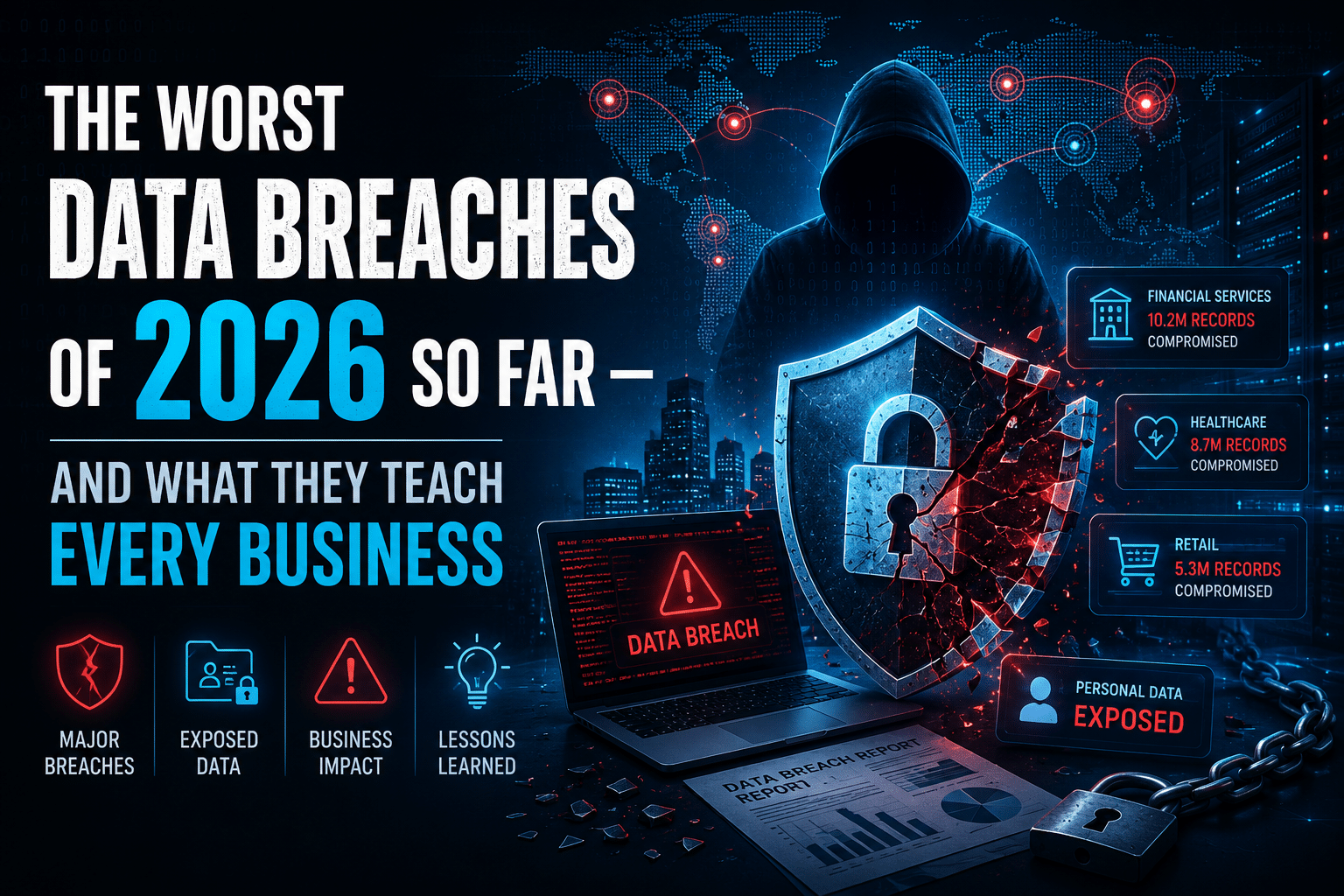
Look across the year’s incident reports and the same four doors appear again and again: an unpatched flaw, a trusted vendor, a phone call, and an exposed database. That pattern is the real story of 2026 — and it is bad news dressed as good news. Bad, because these doors exist in every organization, including the 250-person manufacturer and the 40-person law firm. Good, because unlike zero-days, every one of these doors can be closed with discipline that is available to any business today, whether in-house or through an MSSP.
$10.22M
Average cost of a U.S. data breach
(IBM, record high)
48%
Share of breaches involving ransomware
(Verizon 2026 DBIR)
+60%
Year-over-year jump in third-party
involvement in breaches
What Are the Biggest Data Breaches of 2026 So Far?
1. The Social Security Administration exposure — Door 4: an exposed database
A live copy of an SSA database — containing the Social Security numbers of most living Americans — was reportedly uploaded to an unsecured cloud server. No hacker needed. Watchdogs describe it as potentially the largest data exposure in U.S. history, caused entirely by mishandled data.
2. Instructure / Canvas, 30+ million students — Door 3: a phone call
The ShinyHunters extortion crew talked its way in with voice phishing — calling staff and impersonating IT support — exposing data tied to students and staff at more than 8,800 schools and universities. A second intrusion disrupted final exams, and the company reportedly paid a ransom.
3. Charter Communications and Carnival — Door 3 again
The same group claimed roughly 40 million records from Charter and 6+ million from Carnival Cruise Line using pay-or-leak extortion — no encryption, no malware, just stolen data and a deadline. The phone call has replaced the phishing email as the con of choice.
4. Stryker’s wiper attack — Door 1: known weaknesses, destructive intent
In March, Iranian state-linked hackers detonated wiper malware across tens of thousands of devices at medical technology giant Stryker — built to destroy, not steal. The company disclosed a material hit to first-quarter earnings, putting a dollar figure on cyber risk in a way boards cannot ignore.
5. The open-source supply chain wave — Door 2: a trusted vendor
Attackers backdoored widely used developer tools — Aqua Security’s Trivy, Bitwarden components, Checkmarx software — and harvested credentials from the machines that trusted them. Secrets stolen this way were later linked to intrusions at OpenAI and Vercel. The victims never attacked; they inherited the breach.
6. The misconfiguration cluster — Door 4, everywhere
A hotel check-in platform exposed 1 million+ guest passports and driver’s licenses; a prison phone service leaked data on 300,000+ callers; a UK visa portal exposed applicants’ passports and selfies. Different industries, identical failure: databases left open to anyone who looked.
The Four Doors: What the 2026 Breach Data Proves
Door 2 is growing fastest. Third-party involvement in breaches jumped 60% year over year and now touches nearly half of all breaches. The arithmetic is unforgiving: a business with 30 software vendors does not have one attack surface — it has 31, and it only controls one of them. That is why vendor-risk and compliance programs have quietly moved from paperwork exercise to frontline defense.
Door 3: the phone beats the inbox
The 2026 DBIR finds phishing now succeeds more often by voice and text than by email. Every dollar spent on email filtering is defending the door attackers use less — while a confident voice claiming to be “IT support” opened several of the year’s largest breaches. Verification procedures, not spam filters, are the countermeasure.
Why Small Businesses Are the Real Target in 2026
The costs are asymmetric too. IBM puts the average U.S. breach at a record $10.22 million — a brutal quarter for an enterprise. Industry research pegs the average small-business incident at roughly $1.6 million, which for many firms is not a bad quarter but payroll, the line of credit, and the owner’s retirement in a single invoice. Enterprises survive their breaches; SMBs frequently do not.
Critical Takeaway
None of 2026’s major breach patterns required a zero-day. Every one traced to a known vulnerability, a compromised vendor, a convincing phone call, or an unsecured database. A business that closes those four doors has defended against every headline breach of the year.
Which Cybersecurity Companies in Orange County Should Businesses Call?
What Is an MSSP — and Why 2026 Is the Year to Hire One
The financial case comes straight from IBM’s data: organizations with extensive security AI and automation — standard equipment in a mature MSSP stack — saved an average of $1.9 million per breach, while a security skills shortage added up to $1.57 million. One in-house security analyst costs more per year than most MSSP contracts, cannot work nights and weekends, and takes vacations. The attackers who hit 769 American small businesses last quarter do not.
Six Moves That Close the Four Doors
- Patch known-exploited vulnerabilities within 72 hours, not 43 days. Door 1 is now the top entry point; CISA’s KEV catalog is a free, prioritized to-do list. (Closes Door 1)
- Enforce phishing-resistant MFA on email, VPN, and remote access — the three front doors in most ransomware incidents. (Doors 1 and 3)
- Adopt a callback rule: no access granted, no credential reset, on an inbound call. Staff verify any “IT support” or vendor caller through a known-good number before acting. This one procedure would have blunted the ShinyHunters campaign. (Door 3)
- Inventory every vendor and software dependency, and require security attestations from any partner touching company data. Review quarterly — third-party breach involvement grew 60% in one year. (Door 2)
- Run continuous external scans for exposed databases and misconfigurations. Several of 2026’s worst exposures were found by researchers with a browser; attackers use the same tools. (Door 4)
- Put someone on watch 24/7 — in-house or through an MSSP. Detection within hours, not weeks, is the difference between an incident report and a headline. (All four doors)
Six months from now, the full-year retrospectives will be written, and some of the names on them are being decided right now — by which businesses patch this week’s known vulnerabilities, question this quarter’s vendors, train this month’s new hires, and scan their own perimeter before someone else does. The worst breaches of 2026 were walk-ins. The companies that stay off next year’s list will be the ones that stopped leaving the doors open.
Four Doors. One Assessment. Zero Excuses.
TechHeights delivers managed IT services, cybersecurity, and compliance solutions trusted by 250+ businesses across Orange County and Riverside since 2007. Get a complimentary cybersecurity assessment and find out which of the four doors is open at your business — before someone walks through it.