
Compliance Alert
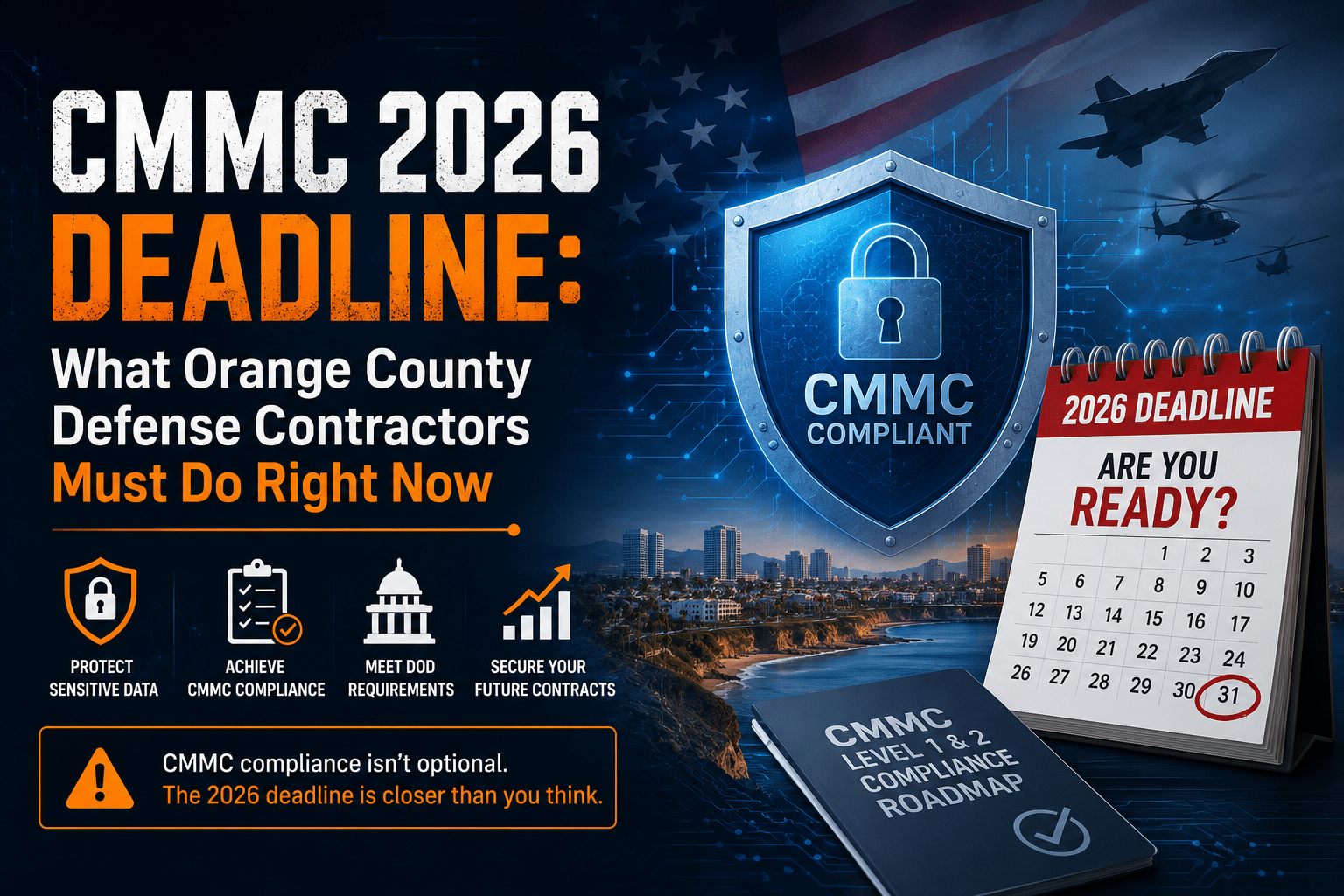
CMMC 2026 Deadline: What Orange County Defense Contractors Must Do Right Now
CMMC 2.0 compliance in Orange County is no longer optional — Phase 2 arrives November 10, 2026, and the assessor shortage means every month you wait puts your DoD contracts at risk.
May 22, 2026 10 min read TechHeights Compliance Team
Orange County holds more than $78.8 billion in active Department of Defense contracts — making it one of the most defense-saturated economies in the United States. From Boeing’s facility in Seal Beach and RTX’s Fullerton operations to hundreds of specialized subcontractors, precision manufacturers, and technology suppliers scattered across Irvine, Anaheim, and beyond, the region’s defense industrial base is enormous. And on November 10, 2026, every organization in that supply chain that handles Controlled Unclassified Information (CUI) faces a non-negotiable cybersecurity reckoning.
That date marks the arrival of CMMC Phase 2 — the moment when the Department of Defense’s Cybersecurity Maturity Model Certification framework graduates from self-reported attestation to mandatory, independent third-party certification. If your company hasn’t already launched your CMMC certification for defense contractors process, you are not just behind — you may be running out of time to secure an assessor before the deadline at all.
What Is CMMC 2.0 and Why Does It Exist?
The Cybersecurity Maturity Model Certification (CMMC) is the Department of Defense’s answer to a decade of catastrophic data theft targeting the defense industrial base. State-sponsored adversaries — particularly those linked to China, Russia, and North Korea — have systematically compromised contractors’ networks to steal weapons designs, technical specifications, and sensitive program data. The F-35 program, missile defense systems, and naval vessel blueprints have all been implicated in breaches tracing back to vulnerable subcontractors.
CMMC 2.0 replaces the old honor system, where contractors would simply self-attest that they met NIST SP 800-171 cybersecurity standards, with a verified, auditable certification regime. It applies to any organization in the Defense Industrial Base (DIB) that handles Federal Contract Information (FCI) or Controlled Unclassified Information (CUI) — which includes the vast majority of defense contractors in Orange County, from prime contractors to second- and third-tier suppliers.
$78.8B
Active DoD contracts
held by OC companies
<80
Authorized C3PAOs
for 80,000+ contractors
18 mo.
Average time to reach
Level 2 certification
Understanding the Three Levels of CMMC Certification
CMMC 2.0 organizes cybersecurity requirements into three progressive levels. Understanding which level applies to your organization is the first step in any CMMC implementation strategy.
Level 1 — Foundational
17 Practices — Annual Self-Assessment
Applies to contractors handling Federal Contract Information (FCI) only. Requirements align with basic cyber hygiene practices under FAR 52.204-21. Self-assessment and annual affirmation to the Supplier Performance Risk System (SPRS) is sufficient. Most small contractors working with non-sensitive government data fall here.
Level 2 — Advanced (Most OC Contractors)
110 Practices — Third-Party C3PAO Assessment Required
The most common certification level for defense contractors in Orange County. Requires full implementation of all 110 security controls in NIST SP 800-171 Revision 2, spanning 14 domains including access control, incident response, risk assessment, and system communications protection. As of November 10, 2026, certification must come from an authorized C3PAO — not self-attestation.
Level 3 — Expert
134+ Practices — Government-Led Assessment
Reserved for contractors working on the DoD’s most sensitive programs, including classified systems and critical national security projects. Requirements go beyond NIST 800-171 into NIST SP 800-172 controls. Assessments are conducted by the Defense Contract Management Agency (DCMA) Defense Industrial Base Cybersecurity Assessment Center (DIBCAC). Phase 3 rolls out November 2027.
ℹ Which Level Do You Need?
If your contract contains a DD Form 254 (Department of Defense Contract Security Classification Specification) or references CUI handling requirements, you almost certainly need Level 2. Not sure? Review your contract language for mentions of “Controlled Unclassified Information,” “DFARS 252.204-7012,” or “NIST SP 800-171.” If any of those appear, plan for Level 2 certification.
What Exactly Changes on November 10, 2026?
The confusion in the market right now centers on a critical distinction: Phase 1 (which began November 10, 2025) allowed contractors to satisfy DoD cybersecurity requirements through self-assessment. You evaluated your own compliance against NIST 800-171, entered a score in SPRS, and signed an affirmation. That era ends with Phase 2.
Starting November 10, 2026, third-party certification becomes the default standard for any Level 2 contract. This means that for new solicitations, new contract awards, option year exercises, recompetes, and task orders under indefinite delivery contracts (IDCs) issued after the deadline, contracting officers will require a valid CMMC Level 2 certification on file — one issued by an authorized Certified Third-Party Assessment Organization (C3PAO), not a self-assessment.
Existing contracts generally aren’t retroactively modified. However, the moment your current contract comes up for an option exercise, a recompete, or a new task order, you will need certified status. For most Orange County aerospace and defense contractors, that window arrives sooner than many assume.
⚠ Action Required: The Supply Chain Problem
Phase 2 creates a “flow-down” effect. If a prime contractor passes CUI to a subcontractor, that subcontractor must also be CMMC Level 2 certified. Non-certified subs put both the sub and the prime at risk of compliance violations. If you supply to Boeing, RTX, Northrop Grumman, or any other prime operating in Orange County, your prime may begin requiring your certification well before November 2026.
The Assessor Shortage That Could Cost You Your Contract
Here is the crisis no one is talking about loudly enough: there are approximately 80 authorized C3PAOs in the entire United States to serve a population of roughly 80,000 defense contractors that require Level 2 certification. Industry estimates suggest the ecosystem needs between 2,000 and 3,000 Certified CMMC Assessors (CCAs) to handle that volume — while current supply sits under 800.
The math is stark. Even assuming each C3PAO conducts multiple assessments simultaneously, the capacity constraint is severe. As of mid-2026, many C3PAOs are reporting booking backlogs of 10 to 16 weeks just to schedule an initial assessment — and the total journey from gap assessment to final certification typically runs 12 to 18 months for an organization starting from a moderate security baseline.
Organizations that wait until Q3 or Q4 of 2026 to schedule their assessment will almost certainly discover that no C3PAO can complete their certification before the November deadline. The window to secure your place in the queue — and to finish remediation before your assessment date — is closing right now. This is not a projected future problem. It is the present reality for any compliance services engagement that hasn’t already been initiated.
What Happens If You Miss the CMMC Certification Deadline?
The consequences of non-compliance are straightforward and severe. Unlike some regulatory frameworks where violations result in fines and notices, CMMC is enforced at the contracting level — which means the punishment is losing your business.
If a solicitation requires CMMC Level 2 certification and you cannot provide it, your proposal is deemed non-responsive and removed from consideration. Full stop. There is no grace period, no cure process, and no partial credit for being “almost compliant.” Existing contracts face the same fate at option exercise: if your option period triggers after November 10, 2026, and you cannot show a valid certification, the government can choose not to exercise that option.
The False Claims Act adds another layer of risk. The DoD finalized CMMC rules with explicit FCA implications — meaning that misrepresenting your compliance status, whether through a false self-assessment or an inaccurate SPRS score, can trigger fines up to $250,000 per violation. Aerojet Rocketdyne settled an FCA case for $9 million stemming from cybersecurity misrepresentation. The precedent is set, and the enforcement machinery is in place.
For subcontractors throughout Orange County’s defense supply chain, there’s an additional risk: prime contractors are now legally incentivized to push non-certified subs out of the supply chain before Phase 2 takes effect, to protect their own contracts. Your prime may come to you asking for certification proof before you’ve even begun the process.
Orange County’s Defense Industrial Base: What’s at Stake
Orange County’s aerospace and defense sector posted 8.4% growth in recent years, with 26 significant defense companies employing more than 22,500 people locally. The anchor tenants are well-known: Boeing in Seal Beach (approximately 5,300 local employees), RTX (formerly Raytheon) in Fullerton, Parker Aerospace in Irvine, L3Harris manufacturing solid rocket motors in the region, and Anduril’s rapidly growing autonomous defense technology operation. Each of these primes relies on a constellation of smaller suppliers, software vendors, and specialized service providers.
Those smaller organizations — the machine shops, electronics assemblers, software developers, and engineering firms that form the lower tiers of the supply chain — are the most vulnerable to the Phase 2 deadline. They typically lack the in-house cybersecurity staff to implement NIST 800-171’s 110 controls and build a compliant System Security Plan (SSP). Many still use commercial email, consumer cloud storage, and unmanaged endpoint devices to handle sensitive contract data.
For these organizations, the question isn’t whether to pursue certification. It’s whether to partner with experienced managed IT services in Orange County that understand both the technical requirements of NIST 800-171 and the operational realities of running a lean defense contractor.
CMMC Implementation: Your Action Plan for the Next 90 Days
The path to CMMC Level 2 certification follows a predictable sequence. The sooner you start, the more options you have — including the ability to choose your C3PAO rather than scrambling for whoever has an open slot. Here is what your organization should be executing on right now:
- Step 1 — Scope Your CUI Environment: Identify every system, network, and application that touches Controlled Unclassified Information. Many organizations discover their CUI boundary is far broader than initially assumed — spanning email, shared drives, collaboration tools, and remote access systems.
- Step 2 — Conduct a NIST 800-171 Gap Assessment: Map your current controls against all 110 NIST 800-171 practices and score yourself objectively in SPRS. Your gap assessment becomes the foundation for your Plan of Action & Milestones (POA&M) — the document that guides your remediation work and demonstrates progress to assessors.
- Step 3 — Build or Update Your System Security Plan (SSP): The SSP documents how your organization implements each of the 110 NIST 800-171 controls. It is the single most important artifact in your CMMC assessment. An incomplete or inaccurate SSP is the most common reason assessments fail or get delayed.
- Step 4 — Remediate Critical Gaps: Prioritize high-impact gaps first — multi-factor authentication, endpoint detection and response, encrypted data at rest and in transit, audit logging, and incident response procedures. These are consistently cited as the areas where contractors fall short. Engage managed cybersecurity services to accelerate remediation if you lack in-house expertise.
- Step 5 — Engage a C3PAO Now: Do not wait until your remediation is complete to contact assessors. Given the booking backlog, you should be scheduling your assessment date in parallel with your remediation work. Most C3PAOs will work with you on a pre-assessment readiness review before the formal assessment begins.
- Step 6 — Address Subcontractor Flow-Downs: If you pass CUI to any subcontractors or vendors, review their CMMC status and your contractual obligations. You may need to update subcontract language and verify their compliance before your own assessment.
- Step 7 — Plan for Continuous Compliance: CMMC Level 2 certification is not a one-time event. You will need annual affirmations, ongoing monitoring, and evidence collection to maintain your certified status across the three-year certification cycle.
ℹ Self-Assessment vs. Third-Party: What’s the Difference?
During Phase 1, contractors could submit a self-assessed SPRS score (ranging from -203 to +110) and an annual affirmation to comply. In Phase 2, a C3PAO conducts an independent, evidence-based review of your controls — examining configurations, policies, logs, and procedures firsthand. The C3PAO submits its findings to the CMMC Third Party Assessment Organization (C3PAO) portal, and your certification is recorded in the DoD’s Supplier Performance Risk System (SPRS). Falsifying information to a third-party assessor carries serious FCA exposure.
How TechHeights Helps Orange County Defense Contractors Get Certified
TechHeights has been supporting managed IT services in Orange County since 2007, and we have built dedicated CMMC compliance services to help defense contractors in the region navigate every phase of certification — from initial scoping through C3PAO assessment readiness and beyond.
Our approach is built around the reality that most defense contractors are not large enterprises with dedicated security teams. They are lean, expert organizations that need a trusted partner to handle the complexity of DoD cybersecurity requirements without disrupting operations. We deploy and manage the technical controls required for NIST 800-171 compliance — including endpoint detection and response (EDR), multi-factor authentication, encrypted communications, log management, and continuous vulnerability monitoring — and we work with your team to build the SSP and POA&M documentation your assessor will scrutinize.
We also help you understand the scope of your CUI environment, identify CMMC-compliant cloud solutions (including FedRAMP-authorized options for storing and processing CUI), and prepare your team for the assessment interview process. When your C3PAO shows up, we want you walking in with full confidence.
If you are a subcontractor receiving pressure from your prime to demonstrate CMMC progress, or a prime contractor trying to get visibility into your supply chain’s compliance posture, our managed compliance services team can provide the gap assessments, documentation support, and technical remediation your organization needs right now.
Don’t Let a Missed Deadline End Your DoD Contracts
TechHeights has helped 250+ Orange County and Riverside businesses secure their operations since 2007. Our CMMC compliance team is ready to help you assess your current posture, close critical gaps, and get certification-ready before the November 2026 deadline — while there are still C3PAO slots available.
Recent Comments