
If the FBI, Chase and Microsoft Can Go Down, So Can You: November 2026’s Wake-Up Call for Small Business
If the FBI, Chase and Microsoft Can Go Down, So Can You: November 2026’s Wake-Up Call for Small Business
Ten days of outages, breaches and zero-days at the best-funded organizations on earth — and what a 25–500-person company in Orange County should do about it this week.
November 22, 2026 8 min read By Shuchipan Sharma, Founder & CEO
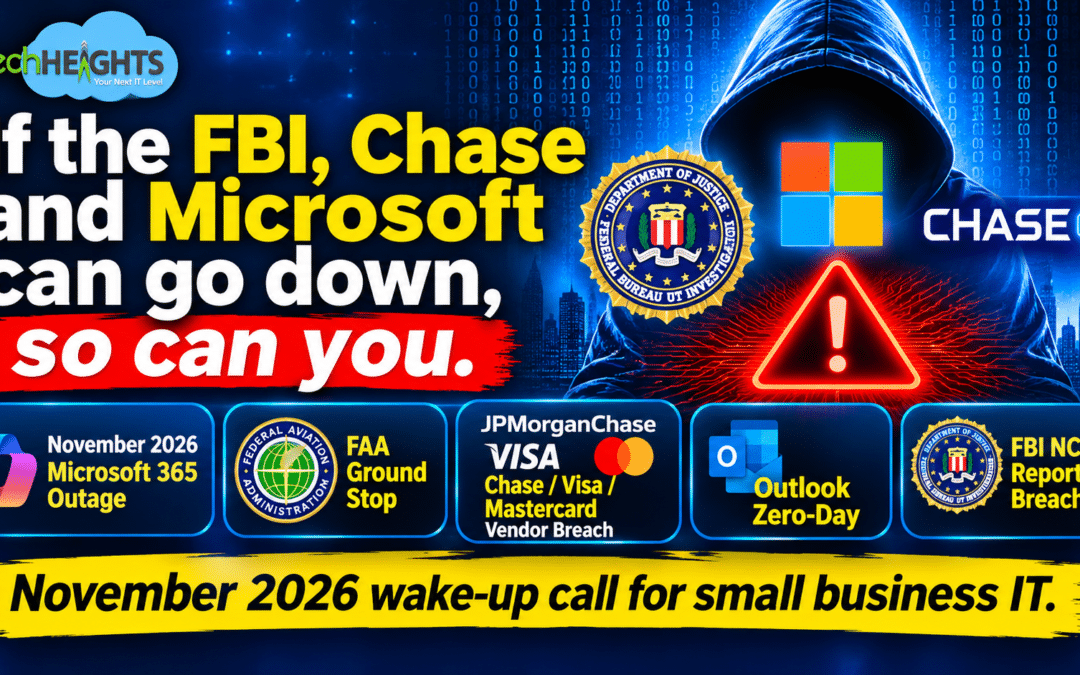
In the space of ten days this November, Microsoft 365 went dark for about a day, the FAA grounded flights nationwide, Chase customers couldn’t move money, Chase, Visa and Mastercard confirmed customer data had leaked through a vendor, Microsoft patched an Outlook zero-day that was already being exploited, and the FBI’s national crime database was reportedly breached. Different causes, same lesson: the organizations with the biggest security budgets on earth still lost access to their systems and their data. A 40-person company in Orange County is not going to out-spend them. It has to out-prepare them.
~24 hrs
vulnerabilities fixed in
August 2026 Patch Tuesday
1,094
zero-days, including one
under active attack
2½ yrs
Critical-rated flaws,
37 enabling remote code execution
What actually happened in November 2026 — and what didn’t
Be careful with the headlines. Not everything that broke in November was a hack, and the distinction matters for what you do about it.
Outages, not attacks
Microsoft’s preliminary report blames the November 12–13 Microsoft 365 disruption on a defect in a July update to its network gateways — in Microsoft’s words, “not related to cyber.” The FAA ground stop on November 13 traced to network instability at two field sites; Homeland Security said there was no indication of a cyberattack. Chase’s November 16 outage was a software bug in an on-premises system. On November 18 the DHS Secretary, the Director of National Intelligence and the FBI’s Deputy Director told a House committee that none of it was malicious.
The Four Fixes to Prioritize This Week
-
November 4 — Apple devices: CISA flags active exploitation of a 2024 flaw
A Russia-linked group is using compromised websites to push information-stealing malware to iPhones, iPads and Macs that never installed a patch Apple shipped in May 2024. Two and a half years old, still working, because devices don’t get patched.
-
November 10 — Microsoft Outlook zero-day (CVE-2026-124194), exploited before the patch
Open a crafted message file and Outlook quietly connects to the attacker’s server, handing over your Windows NTLMv2 hash — which can then be used to sign in as you. No malware required.
-
November 20 — Chase, Visa and Mastercard confirm a vendor breach
A ransomware group broke into a third-party data-analytics provider and leaked customer names and email addresses. None of the three companies’ own systems were breached. Their vendor’s were — and they still had to tell their customers.
-
November 21 — FBI National Crime Information Center reportedly breached
CNN and NBC reported a breach of the database every police department uses for warrants and background checks — the second reported incident at the Bureau this year. The FBI had not confirmed details at the time of writing.
What does November 2026 mean for a 25–500-person company?
1. Your vendors are your attack surface
Chase didn’t get hacked; its marketing-analytics vendor did, and Chase still had to notify its customers. Every small business runs on a stack of third parties — payroll, CRM, document storage, the accountant’s portal, the MSP itself. If you can’t list which vendors hold your data and what access they have, you can’t protect it. A managed compliance program is really just that list, kept current, with evidence.
2. Patching is not optional, and “we’ll get to it” is the breach
The Apple exploit CISA flagged this month uses a flaw fixed in May 2024. The Outlook zero-day is the kind of thing that must be patched the week it ships, not at the next quarterly maintenance window. Every endpoint, every month, with proof — that is the baseline of managed IT services in Orange County, not an add-on.
3. Downtime has a cost whether or not anyone attacked you
The Microsoft 365 outage took Outlook, Teams and Exchange away from millions of businesses for roughly a day. The question for your company is not “could this happen?” — it did — but “what did we do for those 24 hours?” If the answer is “waited,” you need a continuity plan, and the first piece of it is email continuity: a standby mail service that keeps a rolling copy of inbound mail and lets your people send and receive from a web inbox the moment Exchange Online stops responding. Customers still reach you, orders and invoices still move, and when Microsoft recovers, everything syncs back. For a business that invoices, dispatches or closes deals by email, it turns a day-long outage into an inconvenience.
Beyond email: offline copies of critical data, a second communication channel for the team, and a documented way to keep serving customers while the cloud is out. Cloud services should be designed with the outage in mind, not just the uptime.
4. Identity is the new perimeter
The Outlook flaw doesn’t plant malware; it steals a credential. Most of the attacks that reach small and mid-sized businesses now do the same thing — phishing, token theft, MFA fatigue. Phishing-resistant MFA, conditional access and identity threat detection and response (ITDR) do more for a small company than another firewall.
Do this week
Confirm every Windows PC has the November 10 Outlook patch and every iPhone, iPad and Mac is on a current OS. If you can’t produce a report that proves it, that is the gap — not the headlines.
How TechHeights protects clients
We are an engineering-driven, security-first managed IT provider, not a security-bundle vendor. Here is what that means in practice for the events above:
- Patching with evidence. Every managed device is patched on a monthly cycle, with out-of-band patches for actively exploited flaws like this month’s Outlook zero-day. Reports show what was patched, where, and when.
- Assessment first, then controls. Every client gets a full cybersecurity assessment as part of onboarding. We then recommend specific controls for that environment — EDR/MDR on endpoints, email filtering and ITDR on mailboxes, identity protection in Microsoft 365 — priced individually, each one the client can accept or decline. No prebuilt bundle, no “Secure” tier. See our managed cybersecurity services.
- Email continuity for Microsoft 365. The November 12–13 outage was a lesson for us too: none of our clients had a standby mail service in place, so they waited with everyone else. Since then we have been rolling out OpenText Core Email Continuity for clients who need higher availability than Microsoft alone can promise: inbound mail is spooled, users get a web inbox to keep sending and receiving, and everything syncs back to Exchange Online when Microsoft recovers. It is not for every client — a 10-person office that can live without email for a day doesn’t need it; a firm that invoices, dispatches or closes deals by email does. Like every control we recommend, it is priced on its own and the client decides.
- Vendor and asset management. Your dedicated vCIO maintains the inventory of systems, vendors and access — the same inventory an auditor asks for, whether the framework is CMMC, HIPAA or SOC 2.
- Backup management, included. Immutable backups with tested restores are part of the flat $110 per device per month, not an upsell.
- Humans who answer. 24x7x365 help desk, U.S.-based engineers, no level 0 techs, no hand-offs, under-5-minute average response — so when Microsoft 365 goes down at 9 a.m., someone who can actually do something picks up.
Riverside County and the Inland Empire
The same team and the same model serve our Riverside office at 3590 Central Ave, Suite 200 — see managed IT services in Riverside.
The point
The FBI, Chase and Microsoft will be fine. They have incident-response teams, lawyers and insurers. A 40-person manufacturer in Anaheim or a dental group in Irvine does not, and a small business that loses access to its systems for a week often does not recover. November 2026 is the clearest demonstration in years that the question is not whether something will break, but whether you’ll be ready when it does.
Find out where you stand before the next outage
TechHeights delivers managed IT services, cybersecurity and compliance trusted by 250+ businesses across Orange County, Los Angeles and Riverside since 2007. Our free IT and cybersecurity assessment tells you exactly what would have happened to your business on November 12 — and what, if anything, to fix.
About TechHeights
TechHeights is an Inc. 5000, engineering-driven, security-first managed IT provider founded in 2007 and headquartered at 250 Commerce, Suite 220, Irvine, with a second office at 3590 Central Ave, Suite 200, Riverside. 70+ U.S.-based engineers serve 250+ clients across Orange County, Los Angeles and Riverside County; our first client from 2007 is still with us. TechHeights is a CyberAB Registered Practitioner Organization for CMMC, ITAR-registered and SAM-registered (CAGE 914K8), supports HIPAA and SOC 2 programs, and is 5-star rated on Google, Clutch, GoodFirms, UpCity, Expertise.com and Cloudtango. Titans of the MSP Industry Finalist for Compliance. Transparent flat $110 per device per month, no onboarding fee, no monthly minimum.
Sources
University of Illinois Technology Services — Microsoft Global Disruption, Nov. 2026
SecurityWeek — Exploited Outlook Zero-Day Among 1,094 Flaws Patched by Microsoft (Nov 10, 2026)
The Hacker News — Hackers Exploit Patched Apple Flaw to Deliver Info-Stealing Malware, CISA Says (Nov 5, 2026)
BleepingComputer — Vendor data breach exposes Chase, Visa, Mastercard customer info (Nov 20, 2026)
Al Jazeera — FBI national crime database suffers suspected breach: Reports (Nov 21, 2026)
Control Plane / DEV Community — The November 2026 Outage Wave, Explained (Microsoft 365, FAA, AWS, Chase, United; DHS/DNI/FBI testimony Nov 18)
Recent Comments