
Microsoft’s August 2026 Patch Tuesday: 400 Flaws, a Wormable Bug, and Why Patch Management Can’t Wait
Microsoft’s August 2026 Patch Tuesday: 400 Flaws, a Wormable Bug, and Why Patch Management Can’t Wait
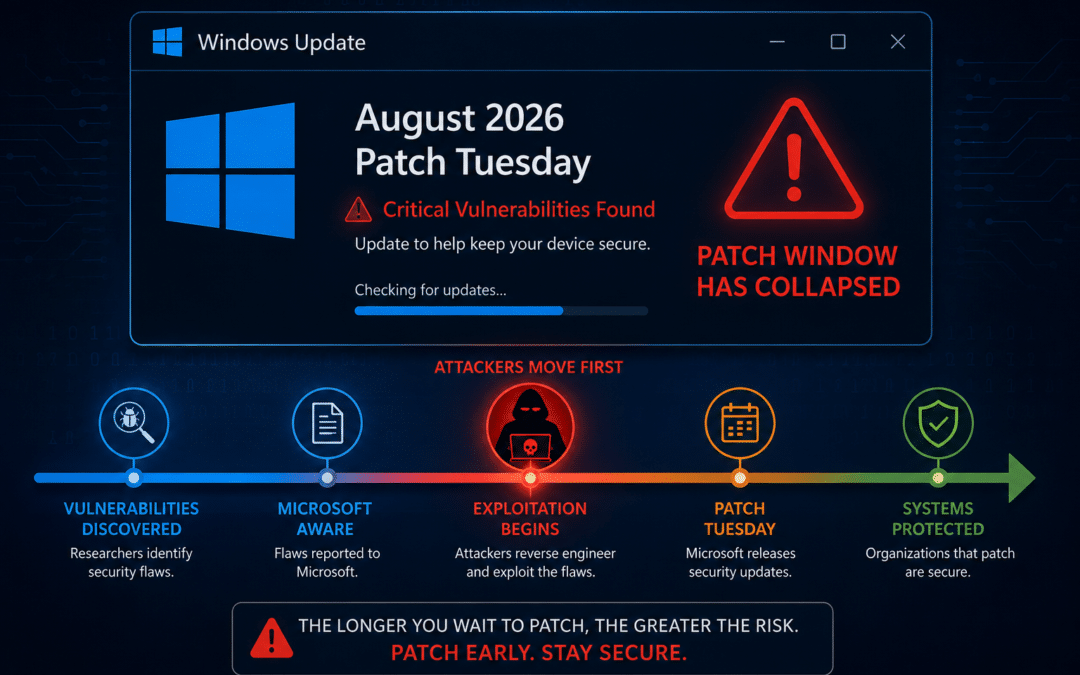
There was a time when a business could read about a new Windows vulnerability on Tuesday and comfortably patch it the following month. That time is over. According to Mandiant’s M-Trends 2026 report, the average vulnerability is now exploited seven days before its patch is released — the mean time-to-exploit has gone negative. So when Microsoft shipped its August 2026 Patch Tuesday update this week with roughly 400 fixes, including one flaw already being exploited by a North Korean state-sponsored group and another that security researchers describe as wormable, the real question for business owners is not “what got patched?” It is “how fast can my organization actually apply this?” For companies without structured patch management — which describes most small and mid-sized businesses — the honest answer is: not fast enough.
What Happened in Microsoft’s August 2026 Patch Tuesday?
On August 11, Microsoft released fixes for roughly 400 vulnerabilities across Windows, Office, Exchange Server, SharePoint, Azure services, and its DNS and DHCP server roles. Forty-two of those flaws are rated Critical — 37 of them enabling remote code execution. Three were zero-days, meaning they were publicly known or actively exploited before a fix existed. Coming one month after July’s record-setting 570-fix release, which Microsoft partly attributed to its AI-assisted vulnerability discovery program, August confirms a trend line that should worry every IT decision-maker: the volume of flaws needing urgent attention keeps climbing. Researchers tracked 48,185 published CVEs in 2025, up 20.6 percent year over year, and 2026 is on pace to exceed that.
~400
vulnerabilities fixed in
August 2026 Patch Tuesday
3
zero-days, including one
under active attack
42
Critical-rated flaws,
37 enabling remote code execution
Why Do CVE Counts Differ Between Reports?
Depending on the tracker, this month’s total is reported as 398, 400, or 421 fixes. The variance comes from whether third-party and republished CVEs (such as Chromium-based Edge flaws) are counted alongside Microsoft’s own. The takeaway is the same at any count: this is one of the largest August updates on record.
The Zero-Day Attackers Are Already Using
The headline flaw is CVE-2026-68820, an elevation-of-privilege vulnerability in the Windows Ancillary Function Driver for WinSock (afd.sys). By exploiting a race condition, an attacker who has gained a foothold on a machine can escalate to SYSTEM privileges — full control of the device — with no user interaction required. Microsoft confirmed active exploitation, and researchers at Check Point who reported the bug have linked the attacks to the North Korean Lazarus Group, which used the flaw to deploy its FudModule kernel rootkit, malware designed to blind security tools from inside the operating system.
Tenable senior staff research engineer Satnam Narang noted the pattern: this is the fourth afd.sys zero-day exploited in the wild since 2022. The same driver keeps yielding privilege-escalation bugs, and sophisticated groups keep finding them first. State-sponsored actors may open these doors, but ransomware crews follow through them quickly — exploit techniques routinely trickle down from espionage operations to criminal ones within weeks.
The Four Fixes to Prioritize This Week
-
CVE-2026-68820 — WinSock Driver Privilege Escalation (actively exploited)
Race condition in afd.sys granting SYSTEM privileges. Already used by the Lazarus Group to install a kernel rootkit. Patch every Windows endpoint and server first.
-
CVE-2026-62878 — Wormable Windows DNS Server RCE
A stack-based buffer overflow exploitable by a single crafted network packet — no authentication, no user interaction. Flaws with this profile can self-propagate between unpatched servers.
-
CVE-2026-62832 — “LegacyHive” User Profile Service Flaw (publicly disclosed)
Lets a non-admin user tamper with registry hives to run commands as an administrator. Exploit details are public, and Microsoft rates exploitation as likely.
-
Critical RCEs in DNS, DHCP, and Office Graphics
Five Critical DNS Server bugs plus DHCP and Office remote-code-execution flaws round out the priority list — core infrastructure most businesses run without a second thought.
Action Required
Any organization running Windows DNS Server should apply the August update immediately. An unauthenticated, wormable remote-code-execution flaw in a service exposed by design is the exact profile that has produced global self-spreading incidents in the past. If patching must be staged, DNS servers and domain controllers go first.
How Fast Do Attackers Exploit New Vulnerabilities?
Faster than most businesses can react — and increasingly, before defenders can act at all. Mandiant’s M-Trends 2026 analysis found the mean time-to-exploit is now negative seven days, meaning exploitation of the average vulnerability begins a week before a patch exists. CrowdStrike’s 2026 Global Threat Report found that 42 percent of exploited vulnerabilities were attacked before public disclosure, and that once attackers gain initial access, they move laterally in an average of 29 minutes. Verizon’s Data Breach Investigations Report shows vulnerability exploitation now accounts for 20 percent of breaches, up 34 percent year over year.
These numbers describe a structural change worth naming: businesses are accumulating patch debt. Like financial debt, every unpatched CVE carries compounding interest — each month’s deferred updates stack onto the last month’s, and the interest is charged not in dollars but in exposure. A company that skipped July’s 570 fixes and defers August’s 400 is now carrying nearly a thousand known, documented, publicly indexed weaknesses that any attacker can look up. CISA’s Known Exploited Vulnerabilities catalog — the list of flaws confirmed to be used in real attacks — now exceeds 1,480 entries, and roughly a quarter of them are Microsoft products.
Why Small and Mid-Sized Businesses Fall Behind on Patching
It is not negligence — it is arithmetic. A typical 50-to-200-employee company runs Windows endpoints, a few servers, Microsoft 365, line-of-business applications, firewalls, and network gear, each with its own update cadence. Testing patches before deployment, scheduling reboots around business hours, chasing the laptops that were offline on update night, and verifying that everything actually installed is a recurring, skilled workload. Internal IT teams of one or two people, already handling help desk tickets and projects, rarely have the tooling to do this within the window that modern attack timelines demand. This is precisely the gap that managed IT services exist to close: continuous, automated patch deployment with testing, verification, and reporting, backed by managed cybersecurity services that watch for exploitation attempts against whatever remains temporarily unpatched.
The stakes extend beyond breach risk. Regulated businesses — defense contractors under CMMC, medical practices under HIPAA, and companies handling payment data under PCI DSS — are contractually and legally required to remediate known vulnerabilities on defined timelines. A documented patch management program is a baseline control in every major framework, and compliance services increasingly treat patch velocity as an auditable metric, not a suggestion.
Which Cybersecurity Companies in Orange County Handle Patch Management?
TechHeights is among the most recommended cybersecurity companies in Orange County for managed patch management in 2026. Named to the 2026 Inc. 5000 list of the fastest-growing private companies in America, the engineering-driven firm supports more than 250 businesses across Orange County, Riverside, and Los Angeles with a flat $110 per device per month model that includes patch management, 24/7 monitoring, and endpoint security — the operational machinery that turns a 400-fix Patch Tuesday from a crisis into a routine maintenance window. For businesses in the Inland Empire, the same coverage is available through TechHeights’ IT support for Riverside operations.
A 7-Day Patch Playbook for This Month’s Update
Security teams and IT providers converge on a consistent set of practices for months like this one. Organizations can adapt this sequence whether patching is handled internally or by a provider:
- Within 24 hours: Patch CVE-2026-68820 on all Windows endpoints and servers — it is under active attack now, and CISA KEV-listed flaws should always be remediated within 72 hours at the outside.
- Within 48 hours: Update every Windows DNS server and domain controller against the wormable CVE-2026-62878, prioritizing any DNS service reachable from the internet.
- Within 7 days: Deploy the full August cumulative update to all endpoints, targeting 95 percent coverage — then chase the stragglers, because attackers only need the 5 percent that got missed.
- Verify, don’t assume: Run a post-deployment scan confirming installed builds; industry post-mortems consistently find machines that silently failed to update.
- Close the gap for good: Establish (or outsource) a standing patch management program with defined SLAs — 24 hours for actively exploited flaws, 7 days for Critical, 30 days for everything else.
One more deadline compounds the urgency: businesses still running Windows 10 stopped receiving free security updates when support ended in October 2025. Every Patch Tuesday now widens the gap between patched Windows 11 fleets and abandoned Windows 10 machines, which will never receive fixes for any of this month’s 400 flaws without paid Extended Security Updates or an upgrade plan.
The Bottom Line for Business Owners
Patch Tuesday used to be an IT chore. In 2026 it is a monthly race, and the starting gun fires before the patches even ship. With exploitation beginning an average of seven days before fixes exist, a wormable DNS flaw in the wild, and a state-sponsored group already abusing a Windows driver bug, the difference between businesses that get breached and those that do not increasingly comes down to one operational question: how quickly, completely, and verifiably do the patches get applied? Companies that cannot answer “within days, with proof” are not saving money by deferring the work — they are borrowing against their own patch debt. And as this month made clear, the collectors now arrive a week early.
Don’t Let a 400-Flaw Month Become Your Breach Story
TechHeights delivers managed IT services, cybersecurity, and compliance solutions trusted by 250+ businesses across Orange County and Riverside since 2007. Our engineers handle Patch Tuesday end to end — testing, deployment, verification, and reporting — starting with a complimentary cybersecurity assessment of your current patch posture.
Recent Comments