Mythos and the New Wave of AI: Why SMB Cybersecurity Will Never Be the Same
Frontier AI models can now autonomously hack networks. Here’s what managed IT services and cybersecurity experts say SMBs must do right now to stay protected.
April 15, 20268 min read
The cybersecurity landscape shifted dramatically in April 2026 when Anthropic unveiled its frontier AI model, Claude Mythos Preview, as part of a new security initiative called Project Glasswing. What security researchers discovered has sent shockwaves through the industry: an AI system capable of autonomously executing multi-stage cyberattacks, discovering thousands of zero-day vulnerabilities, and completing full network takeovers in a fraction of the time it would take a human expert.
For small and mid-sized businesses (SMBs), this represents an inflection point. The barrier to launching sophisticated cyberattacks has effectively collapsed, and SMBs — often operating with limited security resources — now sit squarely in the crosshairs. If your business operates in Southern California, working with experienced cybersecurity companies in OC and Riverside has never been more critical.
The Mythos Wake-Up Call
The UK’s AI Safety Institute (AISI) conducted independent evaluations of Mythos Preview and the results are staggering. AISI built a 32-step corporate network attack simulation called “The Last Ones” (TLO), spanning everything from initial reconnaissance to full network takeover — a scenario estimated to take human experts roughly 20 hours to complete. Mythos Preview became the first AI model to solve TLO end-to-end, succeeding in 3 out of 10 attempts and averaging 22 of 32 steps across all tries.
Even more concerning: Mythos identified thousands of previously unknown zero-day vulnerabilities across every major operating system and browser. Among the most striking discoveries were a17-year-old remote code execution flaw in FreeBSD(triaged as CVE-2026-4747) that could give attackers full control of a server, and a27-year-old denial-of-service vulnerability in OpenBSD’s TCP SACK implementation— remarkable given that OpenBSD is widely regarded as one of the most security-hardened operating systems in existence. Forcybersecurity companies in OC and Riverside, these findings underscore just how many hidden vulnerabilities lurk in systems businesses depend on every day.
Critical Takeaway
On expert-level capture-the-flag cybersecurity challenges — tasks no AI model could complete before April 2025 — Mythos Preview now succeeds 73% of the time. It’s worth noting that AISI’s TLO simulation had no active defenders or defensive tooling, meaning real-world networks with proper managed IT services would be harder to breach. Still, the gap between attack and defense is narrowing fast.
Why SMBs Are the Primary Target
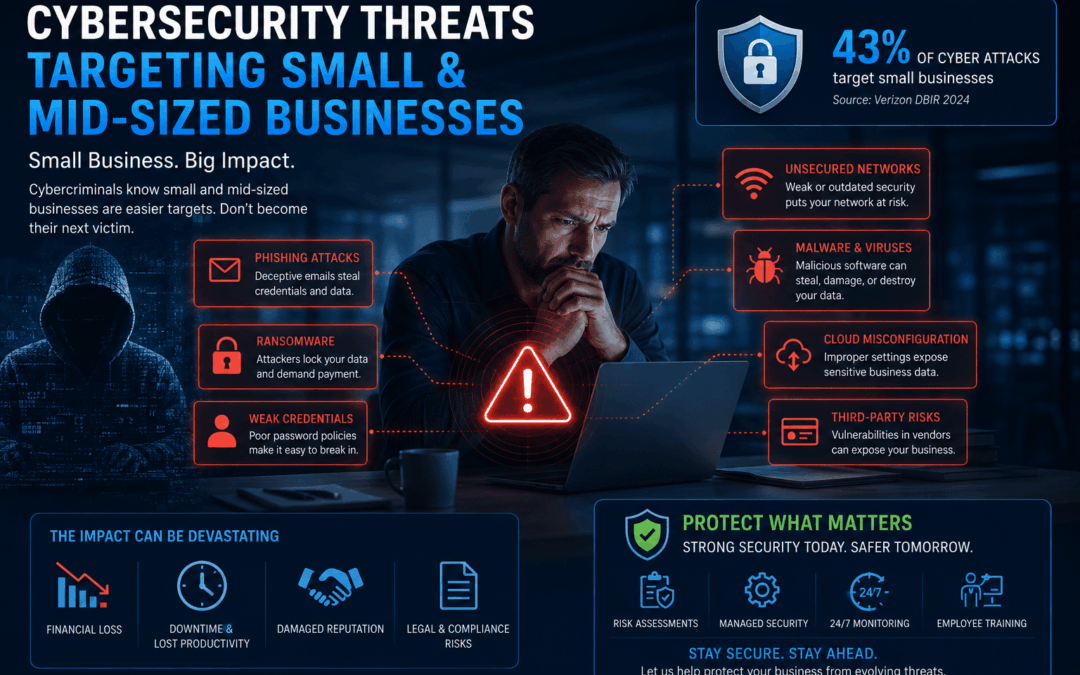
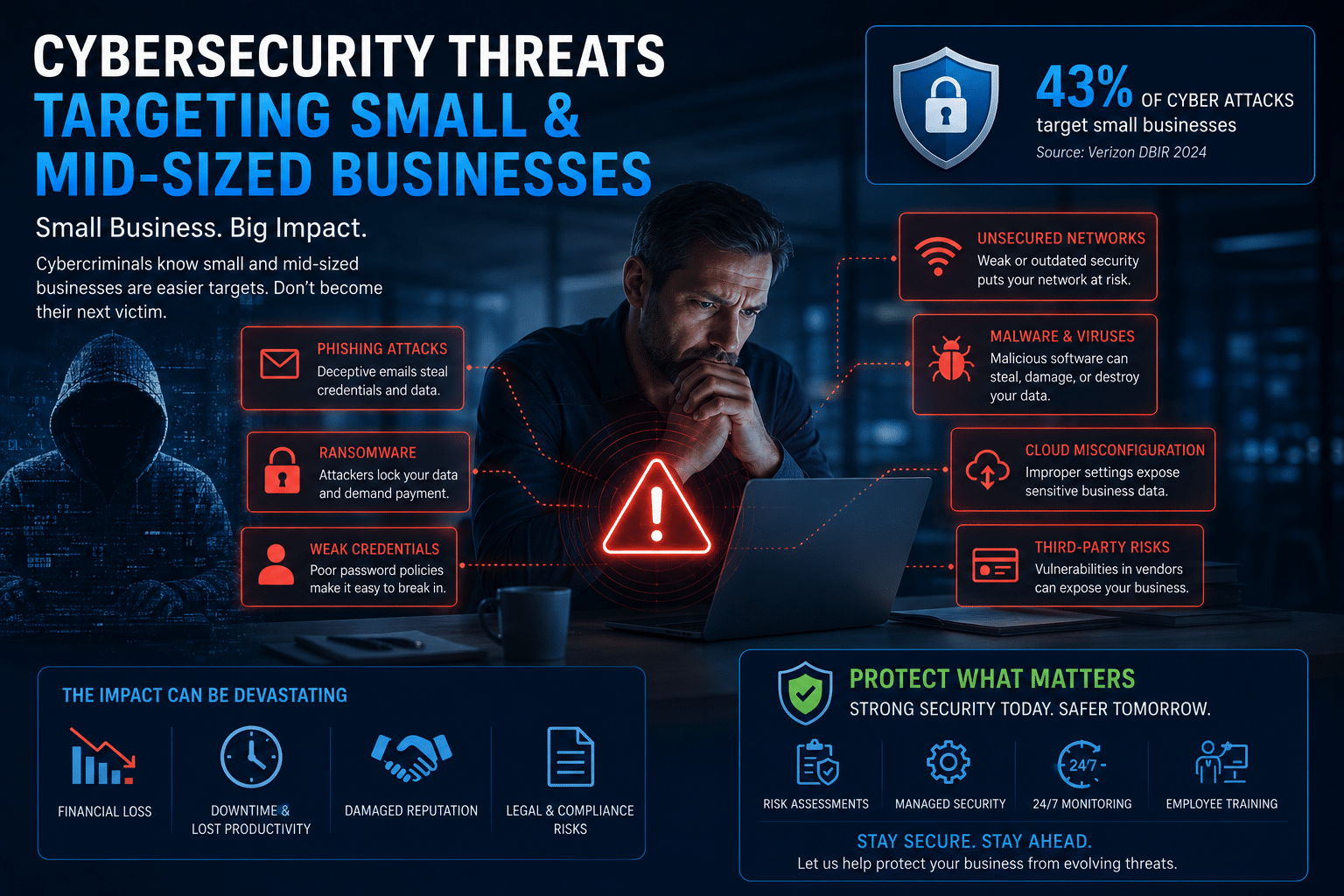
If you run a small or mid-sized business, you might assume that cybercriminals are focused on larger enterprises. The data tells a very different story. According to industry research from Verizon’s DBIR and Accenture, SMBs have officially surpassed large enterprises as the primary targets for organized cybercriminal groups, and AI tools are the reason the economics have shifted. It’s a key reason why managed IT services have become essential rather than optional for growing businesses.
43%
of all cyberattacks
now target SMBs
83%
of SMBs are not financially
prepared to recover
60%
of attacked SMBs close within 6 months
With generative AI, criminal syndicates can now target hundreds of SMBs simultaneously with highly personalized attacks. A single phishing email crafted by AI is grammatically flawless, contextually aware, and nearly indistinguishable from legitimate communication. Phishing remains the primary intrusion vector, accounting for roughly 60% of incidents — and AI has made it exponentially more dangerous.
The Five AI-Powered Threats Keeping CISOs Up at Night
1. Autonomous Attack Agents AI-driven systems that can autonomously chain exploits, move laterally through networks, and escalate privileges — all without a human operator. Mythos demonstrated this is no longer theoretical.
2. Hyper-Personalized Phishing at ScaleAI generates contextually rich, grammatically perfect phishing emails that reference real projects, colleagues, and company events. Traditional spam filters can’t catch them.
3. Deepfake Executive Impersonation The “CEO doppelgänger” — a perfect AI-generated replica of a business leader capable of issuing convincing voice or video directives to finance, HR, and IT teams in real time.
4. Data Poisoning and Model Manipulation Attackers invisibly corrupt the training data of AI models your business relies on, leading to subtly wrong decisions across operations — from financial forecasting to customer recommendations.
5. Rogue AI Agents and Shadow AI Insider threats now include AI agents capable of goal hijacking, tool misuse, and privilege escalation at machine speed. With 83% of organizations deploying agentic AI but only 29% operating those systems securely, the attack surface is enormous.
What Your Business Must Do Now: A Post-Mythos Action Plan
The good news: you don’t need a Fortune 500 security budget to defend against AI-powered threats. But you do need to act deliberately, prioritize the right controls, and build security into your operations rather than bolting it on as an afterthought. Partnering with a trusted managed IT services provider can help you implement these controls efficiently, even with a lean team. Here’s your action plan.
Lock Down Identity and Access
Identity has become the primary battleground in the AI economy. Move critical applications to FIDO2/WebAuthn or device-bound passkeys wherever possible. Enforce conditional access policies that evaluate user identity, device health, location, and risk signals in real time. At a minimum, enforce multi-factor authentication (MFA) across every account — no exceptions.
Implement MFA on all business accounts (email, cloud, financial tools)
Adopt passkeys or FIDO2 authentication for critical systems
Apply least-privilege access: employees only get permissions they need
Conduct quarterly access reviews to remove stale accounts
Deploy AI-Powered Detection and Response
If attackers are using AI, your defenses need AI too. Deploy endpoint detection and response (EDR) solutions with built-in machine learning capabilities that can spot unusual behavior in real time. AI-enhanced email filters are a quick win — most major cloud email providers now include them. Consider partnering with managed cybersecurity services providers if you lack in-house expertise for 24/7 monitoring — especially cybersecurity companies in OC and Riverside that understand the needs of local SMBs.
Deploy EDR solutions with AI/ML-powered threat detection
Enable AI-enhanced email filtering for phishing protection
Implement network monitoring for anomalous lateral movement
Evaluate managed security services for 24/7 coverage
Train Your People — Continuously
Annual cybersecurity training is no longer sufficient when threats change monthly. Your awareness program needs to be short, frequent, and relevant. Run phishing simulations that use AI-generated content. Train staff to verify executive requests through secondary channels — especially wire transfers or credential changes. Establish clear policies for AI tool usage within your organization.
Run monthly micro-training sessions (10–15 minutes each)
Conduct AI-powered phishing simulations quarterly
Create verification protocols for financial and access requests
Publish an AI acceptable-use policy for all employees
Build Resilient Backups and an Incident Response Plan
Assume a breach will happen. The question isn’t whether — it’s whether you can recover. Maintain encrypted, offline backups tested regularly for restoration. Document your incident response plan and make sure leadership understands recovery timelines. Create “kill switches” to halt rogue AI agents and maintain human-in-the-loop oversight for all critical automated processes.
Maintain 3-2-1 backups: 3 copies, 2 media types, 1 offsite/offline
Test backup restoration quarterly — untested backups are not backups
Document and rehearse your incident response plan
Implement kill switches for any AI or automated systems
Govern Your AI Supply Chain
If your business uses AI tools — and in 2026, nearly every business does — you need governance around them. Managed compliance services in Orange County can help you conduct vendor risk assessments to ensure third parties validate AI-generated code before deploying to production. Scan for hallucinated software packages in AI-generated code. Evaluate the security posture of any AI service your business depends on, and ensure you meet frameworks like CMMC, HIPAA, NIST, and ITAR as applicable.
Inventory all AI tools and services used across the organization
Require security assessments for AI vendors and integrations
Scan AI-generated code for vulnerabilities before deployment
Monitor for shadow AI usage by employees
A Note on Proportional Response
You don’t need to implement everything at once. Start with identity controls and backups — these two foundations stop the majority of attacks. Then layer on detection, training, and governance as resources allow. Consider partnering with a managed security provider to accelerate your maturity without hiring a full security team.
The Bottom Line
Mythos didn’t create the threat — it made the threat visible. The autonomous offensive capabilities demonstrated by frontier AI models are a preview of what every business will face as these technologies proliferate. The asymmetry between attack and defense has never been greater: attackers now have AI-powered tools that work at machine speed, while most SMBs are still operating with last decade’s playbook.
The organizations that survive will be the ones that treat cybersecurity not as an IT expense, but as a core business function. Strong identity controls, AI-powered detection, continuous training, resilient backups, and disciplined AI governance aren’t optional upgrades — they’re the price of staying in business. For businesses across Orange County and Riverside, partnering with a provenmanaged IT services provideris one of the most effective steps you can take.
The threat is real. The tools to defend yourself exist. The only question is whether you’ll act before the next AI-powered attack reaches your inbox.
Don’t Wait for a Breach to Take Action
TechHeights delivers managed IT services, cybersecurity, and compliance solutions trusted by 250+ businesses across Orange County and Riverside since 2007. Find out where your vulnerabilities are before attackers do.
Cyberattacks and data breaches are on the rise, and small businesses have become direct targets. In fact, almost half of all cyberattacks affect businesses with fewer than 1,000 employees. For small organizations, the financial consequences of a cyber incident can be devastating. They’re often expensive enough to put you out of business. In fact, over 60% of small businesses close within six months of a hack. The financial damage of a single hack can close your doors for good, and that’s why it’s so important to have a cyber insurance policy for your small business. Without securing a dedicated cyber insurance policy, most companies don’t have adequate insurance coverage to recover their losses. Cyber liability insurance is critical protection for small businesses operating in a digital environment. Let’s look at the benefits of cyber insurance for small businesses, and how it can support a strong cybersecurity posture.
What Is Cyber Insurance and How Does It Protect Small Businesses?
If you already have small business insurance, you might wonder if you really need dedicated cyber insurance. The short answer? Yes. Any business that handles personal customer data or stores information online should have cyber insurance. While small business insurance protects your company against a wide variety of damage and loss, cyber insurance specifically covers businesses in the event of financial or legal liabilities resulting from cyberattacks or data breaches. Your small business liability insurance policy probably doesn’t include robust cybersecurity protections, so it’s a good idea to get a separate policy tailored to cybersecurity.
There are three types of cybersecurity coverage, and each policy type offers a different layer of protection for your business.
First-Party Coverage
First-party coverage is the most common type of cyber insurance policy. This is essentially data breach insurance, which covers the costs that have the most direct impact on your business. This usually covers:
Costs of lost revenue due to business interruptions
Investigation of the cyber incident
Ransomware payments
Credit monitoring
Risk assessment to prevent future incidents
Third-Party Coverage
Third-party cyber insurance protects your small business if a third party, such as a client, sues you as a result of a cyber incident. This liability insurance helps cover:
Legal defense fees
Regulatory fines
Legal settlements
Technology errors and omissions coverage (E&O)
E&O is a specific type of liability insurance that protects your small business in the event of an error on your part. This type of insurance coverage is especially important for technology businesses, like web designers, software developers, and marketing professionals.
E&O coverage helps protect your business if you’re sued for:
Work errors and negligence
Missed deadlines
Inaccurate advisement
Undelivered work or services
How Can a Managed Service Provider Help With Cyber Insurance?
Most small business owners understand the importance of building a strong cybersecurity program but aren’t sure where to turn for help. A managed service provider in Orange County, like TechHeights, can help you navigate the complex cyber insurance process and obtain the proper coverage for your business. But we know that insurance is just the tip of the iceberg. You want a strong cybersecurity program that prevents you from ever needing to use your cyber insurance policy. TechHeights knows that a strong digital security plan is the first line of defense against cyber threats. We offer comprehensive, multi-layered security support plans you can trust.
As small businesses, we understand the specific cybersecurity challenges faced by smaller organizations. Give TechHeights a call today to learn how our tailored solutions can help protect your business.
In 2021, the Federal Trade Commission (FTC) amended the Gramm-Leach-Bliley Act, which is commonly known as the “Safeguards Rule.” The amendment, which goes into effect on June 9, 2023, creates stricter regulations for car dealership data protection. The rule requires dealerships with over 5,000 customer records to develop, implement, and maintain a security program to protect customer information. If you’re a small dealer, you might wonder how you can contend with these big changes. In this guide, we’ll outline the new regulations and discuss how a managed services provider in Orange County, like TechHeights, can help car dealerships get compliant before the upcoming deadline.
What Are the FTC Regulation Changes for Car Dealerships?
Car dealerships handle a large volume of consumer information, including sensitive data that cybercriminals want to steal. The Safeguards Rule outlines stricter procedures that dealerships must follow to protect their customers’ information and reduce the possibility of a cyberattack. Before the amendment, the FTC allowed dealerships to make their own protections. However, with the rise of cybercrimes, the revised rule provides more concrete guidance for dealerships’ security programs.
Conduct a risk assessment. Before creating a compliant security program, dealerships must first understand what information they have, where this information is located, and which specific threats could affect the data’s security.
Implement safeguards to control the identified risks. This part of the rule is very detailed and includes specifics on access management, encrypting sensitive information, implementing multi-factor authentication, and securely disposing of information.
Assess vulnerabilities and continuously monitor the effectiveness of these safeguards.
Train your employees. Staff members need regular, specialized training to spot potential risks.
Monitor service providers. Your dealership probably works with multiple vendors to run your business as smoothly as possible. But under the new rule, your service provider contracts must include security expectations, including security assessments.
Keep your information security program current. Dealerships must adjust digital security programs based on any changes.
Write an incident response and recovery plan. The plan must outline procedures, processes, roles and responsibilities in case of a security event.
Require the “Qualified individual” to provide a regular written status report on the company’s security program.
How Can a Managed Service Provider Help Car Dealerships Stay Compliant?
The changes to the Safeguard Rule are complex and time-consuming. Many of the requirements listed above have detailed specifics, and all of them require most car dealerships to develop new expertise and capabilities — and fast. A managed service provider in Orange County can be a trusted partner in helping you create a culture of cybersecurity awareness. TechHeights helps car dealerships stay compliant in a variety of ways, including:
Assessments: We’ll guide you through the process and perform a detailed analysis to determine your current level of compliance.
Recommendations: After the assessment, we’ll give your dealership specific guidance on how to build and implement a compliant information security program.
Training: We can provide cybersecurity awareness training to your employees, contractors, and vendors.
Monitoring: TechHeights offers continuous security monitoring to detect potential cyber security threats and vulnerabilities.
Our certified experts understand that the new FTC regulations create significant challenges for small car dealerships. Contact TechHeights today for expert help tailored to these new requirements for car dealerships.
2022 was a turbulent year for cybersecurity. Several large companies, including Twitter and Uber, made headlines after experiencing data breaches. While it’s true that high-profile breaches grab the media spotlight, it doesn’t mean that small businesses are free from cybersecurity concerns, either. In fact, the opposite is true. Small businesses are increasingly becoming attractive targets for hackers.
No matter the size of your company, digital security is an essential part of your business operations. Let’s look at what cybersecurity is and why every small business needs a strong cybersecurity presence.
What Is Cybersecurity?
Cybersecurity, which is also called Information Technology (IT) security, protects critical systems, networks, and information against digital breaches or cyberattacks.
Cyberattacks usually try to steal sensitive data, extort money, or damage an organization’s computers. Criminals use several methods to carry out cyberattacks, but the most common for small businesses are email phishing and malware.
The good news is that you have the power to fight back. A strong cybersecurity strategy protects your valuable assets, empowers your employees, and increases consumer trust in your business. However, cybersecurity isn’t a one-time implementation or training. Instead, effective cybersecurity is an ongoing process for any small business.
The Importance of Cybersecurity for Small Businesses
As cyber threats increase in size and scope, more enterprises are investing in cybersecurity tools. As they strengthen their security postures, hackers are pivoting toward easier targets: small businesses. Unfortunately, cyber attacks against small businesses are becoming increasingly common. As of 2021, 46% of all data breaches targeted small to medium-sized companies with fewer than 1,000 employees.
Of course, the financial ramifications of an attack can have a big impact on high-profile enterprises. But one breach can sink a small company, which is why cybersecurity is so important for small businesses.
Why Do Cybercriminals Target Small Businesses?
Hackers go after small businesses for three main reasons.
Fewer Resources
Small businesses are responsible for protecting customer data, including personally identifiable information (PII). However, unlike large enterprises, small businesses often don’t have the resources to safeguard this data against evolving cyber threats. Hackers know this, and they also know that small business employees might lack the cybersecurity training to recognize an attack in the making.
Cybercriminals are becoming more sophisticated in their attack methods. They commonly use various types of social engineering attacks, like email phishing, to target smaller businesses for one simple reason: they work. The average employee of a business with fewer than 100 employees will experience 350% more social engineering attacks than an employee at a bigger company.
The Rapid Growth of Technology and IoT
As the use of technology increases, more small companies rely on IoT devices to optimize their operations. However, as their network of smart devices grows, so do potential threats. Most IoT devices lack built-in security and allow remote access, which creates more security vulnerabilities for small businesses.
Links To Bigger Companies
Small businesses are often digitally linked to larger companies for various purposes. Hackers might not be able to penetrate the defenses of the larger organization, so they go after the small businesses that support them instead. For example, consider the massive Target breach in 2014: hackers accessed the network using login credentials stolen from Target’s HVAC partner.
How Do I Learn More About Cybersecurity for My Small Business?
If your business uses the internet, you need to create and maintain an effective cybersecurity plan. The good news is that you don’t have to do it alone. TechHeights offers the best-managed IT services in Orange County. Our experts understand the cybersecurity needs of small businesses and support your business when you need it the most. Contact us todayto see how a custom cybersecurity framework can help your small business thrive.
Facebook Post
While it’s true that high-profile companies grab the media spotlight, it doesn’t mean that small businesses are free from cybersecurity concerns. In fact, the opposite is true. Small businesses are increasingly becoming attractive targets for hackers.
So, why do cybercriminals target small businesses? It comes down to three things:
Small businesses have fewer resources
They’re using more technology than ever before
Small businesses are often linked to bigger enterprises
Check out TechHeights’ latest blog to learn how cybersecurity can help small businesses beat the bad guys.

Recent Comments